Showing posts with label SOA. Show all posts

Tuesday, August 02, 2011

Does anybody know what data SAP Enterprise Services actually expose?

Anybody know where I could get the mapping of SAP database table & field names to data elements in the WSDL of a standard SAP Enterprise Service? It seems our SAP technical consultant is unable to determine this without manually opening up the ABAP code that comes with SAP. The element names in the Enterprise Service are long English names which are quite different from the German acronym-like names of the standard SAP databases that all the SAP functional consultants are familiar with. It seems very painful to figure out what data is actually being exposed by the Enterprise Service.


Copyright © 2011 by Philip Hartman - All Rights Reserved

The postings on this site are my own and don't necessarily represent IBM's positions, strategies, or opinions.

Wednesday, December 19, 2007

Back to the Real World After China

About 6 weeks ago, I completed one of the most challenging 10 months of my entire 26+ year career. I helped create the Enterprise Service Bus for a major Chinese company and during that time I made six trips to China and spent a total of 4.5 months there. I joked with friends that I did not live in the "real world" anymore because I would have never believed that anyone would actually pay me to work in China for so long. I did, however, learn a lot about globally distributed teams, ESB's, SOA, and the culture clash of trying to make people from China, the US, Canada, and India all work together.

In particular, my job was to help integrate their website with 3rd party service providers and their SAP back end. My resume is now full of references to XML, web services, canonical data modeling (XML schemas), WebSphere Message Broker, and WebSphere Process Server.

It was a heady time but I must confess I'm glad its over. It has taken me several weeks to get back into the groove and sit down and take some time to blog again.

Copyright © 2007 by Philip Hartman - All Rights Reserved

The postings on this site are my own and don't necessarily represent IBM's positions, strategies, or opinions.

Sunday, April 29, 2007

I'd Rather Be Lucky than Good

This isn't my usual type of post because it talks not about concepts or competence but about a stroke of unusually good professional luck.


I was one of 4700 IBMers attending the Technical Leadership Exchange in Anaheim, California. I had just gotten a new assignment to create the canonical data model for my client's new enterprise service bus (ESB). I think of this as the superset of all the many possible data attributes of the major business objects that flow across the ESB. Examples would include purchase order, order acknowledgement, invoice, advance shipping notice, and more. The back end system for all of these transactions is SAP.


There was some training on Sunday before the conference started on Monday. At dinner Sunday night I sat down at a table of strangers and made some IBM smalltalk with my new acquaintances. A few minutes later some other guys sat down. The guy who sat to my immediate left asked me who I was, where I was from, what I was doing, etc.

When I mentioned I was working on a project to create a canonical data model for an ESB, he casually told me "Oh, I've been working on IBM's canonical data model for IBM's ESB for two years. I'm the lead architect." At this point I just about fell out of my chair. I could not believe my good fortune.


I told him I would pick up his dry cleaning and wash his car if he'd tell me everything he knew about canonical data models. He laughed and offered to help me.


To make a long story short, he wound up showing me the canonical data model for IBM's own ESB and pointed me to where I could download XML schemas off the IBM intranet. Incidentally, IBM uses SAP for many of its back end functions. One valuable tidbit of information included was a spreadsheet linking attributes in the canonical form with specific SAP IDOC segments and fields.


In the consulting business we call this "intellectual capital" and wonderful intellectual capital it is. Obviously, this has really jumpstarted my work. I wish I could say that I was really good but in this case I must confess being really lucky (or have I been living right?... that's another discussion).


He never did make me wash his car either. As we said playing basketball after someone said we were just lucky to make a difficult shot. Luck counts!

Wednesday, November 22, 2006

Companies that Need SOA the Most Are Least Likely to Implement It

My eyes were drawn today to an ITBusinessEdge post "Companies that Need SOA the Most Are Least Likely to Implement It". How could I resist that title? (That reminds me of a previous post of mine "Naming Well, an Essential Skill of an I/T Architect" but I degress.) That post in turn drove to yet another cleverly named post

Is SOA success in the genes? by ZDNet's Joe McKendrick -- Todd Biske recently responded to my post about Microsoft's recommended approach to SOA (inch by inch, it's a cinch; mile by mile, its a trial), and ponders whether some organizations can get SOA right away, but others will never get it. How do organizations end up with their IT out of synch with business [...]

The basic premise here is worth entertaining. Companies that already have good alignment of I/T and business, already have good governance in place, already think proactively and strategically about I/T, etc. will find moving to a Service Oriented Architecture just the next incremental step in their improvement process. For the other companies out there (the vast majority?), the gap between where they are today and SOA is an insurmountable chasm that they dare not even try to cross.

I think there is an element of truth. I've seen a lot of situations where a company could benefit from new approaches but because they organize a bunch of independently funded, tactical projects no one project can fund the leap to the next level of maturity and flexibility. (See also "The Scourge of the I/T Architect's Universe".) Just a couple of weeks ago an acquanitance of mine at a major manufacturer told me he was interested in using SOA software products for their EAI-like-middleware value but he didn't think his organization was ready to embrace SOA yet. I guess this is like "flying under the radar" to wait until the political situation is more receptive to SOA.

Copyright © 2006 by Philip Hartman - All Rights Reserved


The postings on this site are my own and don't necessarily represent IBM's positions, strategies, or opinions.

Thursday, November 09, 2006

Musings on Bill Gates, the IT Shortage, and Globalization

I've taken an interest (by necessity) in the globalization of software development (and corporate life in general) so I read with interest "Bill Gates Says West Not Supplying Enough IT Talent" by James Kilner of Reuters. Bill Gates was speaking in Moscow and is quoted as follows:

"Worldwide, a lot of the developed countries are not graduating as many IT students as they were in the past, which is kind of ironic as it does mean it does increase the opportunities."

"There is a shortage of IT skills on a worldwide basis. Anybody who can get those skills here now will have a lot of opportunity."
If you follow the link above to the story about Gates and look at comments posted at the bottom, they were mostly bemoaning the fact that I/T jobs in places like Russia, China, and India pay a lot less than the US and other Western nations. They attributed the "shortage" to a shortage of people willing to work for low wages.

I was probably as nervous as anyone else about the globalization of software development a few years ago. Since then I guess I gotten past my fears. On my best days, I have embraced the idea. On my worst days, I guess I just try to make the best of it.

It does appear to me that CIOs are taking the cost savings of global resourcing and using it to fund additional projects. If they had a budget 5 years ago to do 4 major projects a year then today they are using a similar budget to execute 5, 6, or even 7 major projects. These "extra" projects are often the ones that are the most fun to work on. They would have been "stretch" projects that never got funded in the past. One change that has happened, however, is that those of us in the US are having to play more of a leadership role vs. doing the "heads down" coding.

Another anecdotal piece of evidence that the sky is not falling. I've done some interviewing right here in the US for college graduates. Are we taking just anybody? No, we are being selective. But this is quite an improvement over just a few years ago. We're hiring both overseas and in the "high wage" countries.

By the way, see the Oct 31st article "IBM Plants New SOA Development Centers in India, China" to see that this trend is only accelerating. This is not about using global resources to maintain old code. This is about investments in the latest and greatest SOA technology... and doing it with talent from around the world.

"It's all about business model innovation—giving clients the ability to rapidly change business models by building applications with reusable software components," said Sudhir Sastry, leader of the IBM SOA Solutions Center, in Pune.

Key to the initiative is IBM's WebSphere Business Services Fabric—based on technology IBM recently acquired when it purchased Webify Solutions, Sastry said.

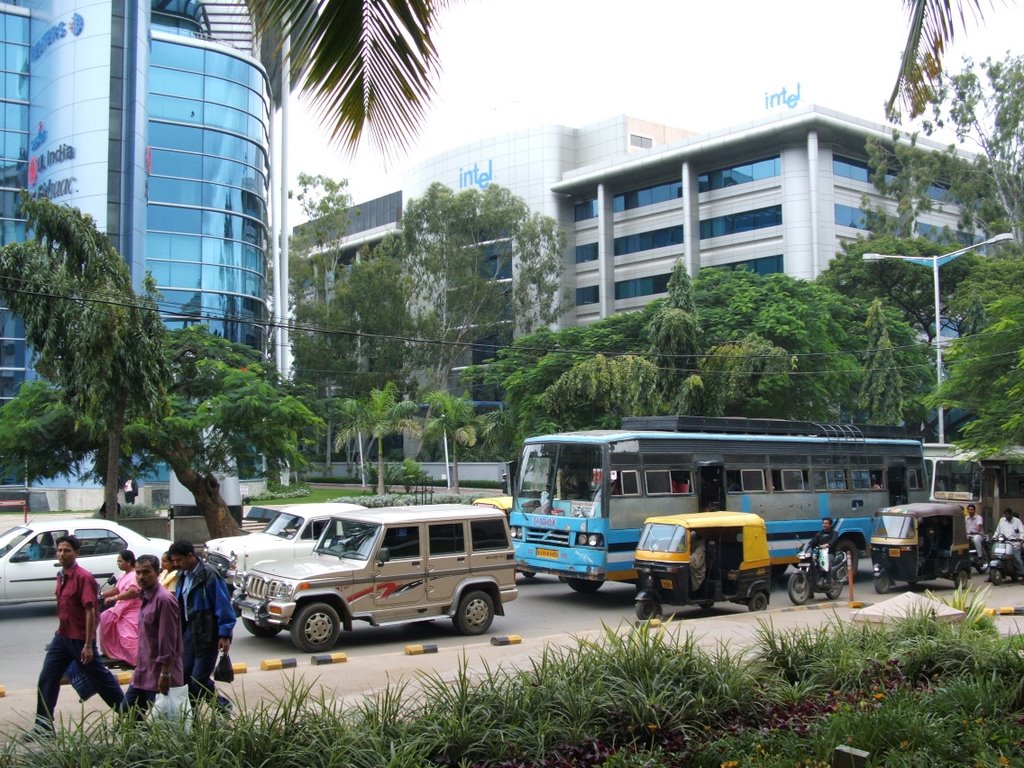
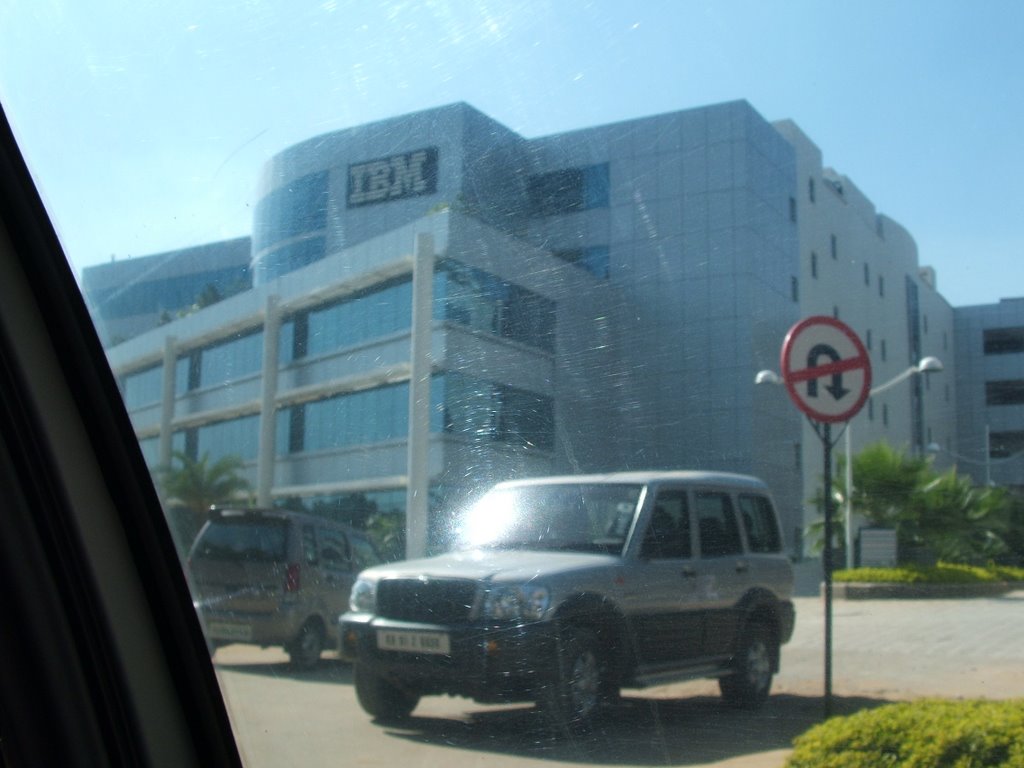
Back in September 2004, I got to make a trip to Bangalore, India. I saw an office building for almost every big-name tech company while I was there. Here's a few samples from my personal photo archives. They aren't great pictures as they were taken through the window of the taxi I was riding in.

First Oracle

  • Next Intel
    IBM
    And finally Microsoft


    Copyright © 2006 by Philip Hartman - All Rights Reserved

    The postings on this site are my own and don't necessarily represent IBM's positions, strategies, or opinions.


Friday, November 03, 2006

Silo-ed Organization Abolishment and Other Variations on the SOA Theme

Brenda Michelson has some clever variations on the acronym SOA in her post Talking "S-O-A" with the Business.

Some of my favorites from her post include:

  • Strategy Offering Agility
  • Stream of Acronyms
  • Seizing Operational Agility
  • Silo-ed Organization Abolishment

The postings on this site are my own and don't necessarily represent IBM's positions, strategies, or opinions.

Tuesday, October 17, 2006

Getting Good Service from SOA

You may find this article interesting regarding benefits being realized by Service Oriented Architecture (SOA). The author makes a point to reference many different companies and give some highlightes of their experiences. Here's a couple of samples:
"At Railinc Corp., a transportation logistics firm based in Cary, N.C., Garry Grandlienard, director of enterprise architecture, notes that many of his company's applications draw on certain basic information about railcars, stored in one main database. Before SOA, changing one element of that database might have meant changing 100 applications. With SOA in place, he may not need to make any application changes at all, since he can change the service layer and it will translate the database change for all applications.

Farmington Hills, Mich.-based RouteOne LLC is an exchange established by the finance arms of General Motors Corp., Ford Motor Co., DaimlerChrysler AG and Toyota Motor Corp. to provide auto dealers with access to a variety of financing options and services. Here, SOA gives CIO Joel Gruber a cost-effective way to make changes to his internal infrastructure without disrupting all the firms that use the exchange. In August, RouteOne began piloting an electronic contract feature, called eContracts, to allow auto dealers to forego paper contracts. Key to the eContracts pilot is a service the company built to test its messaging environment. At RouteOne, a transaction, such as an auto loan application, is treated as a type of message, and the testing environment lets the company see if new message types will cause any problems. "It doesn't sound like a service," notes Gruber. "But it's a utility service that means we don't break anything for our customers when we change something.."

Check out:Getting Good Service
The postings on this site are my own and don't necessarily represent IBM's positions, strategies, or opinions.

Friday, October 13, 2006

A Company that Can Run Itself from Wherever It Makes the Most Business Sense

I found this interesting blurb highlighting the continuing changes in corporate life:

"A job reassignment notice from IBM today signals something more than that another American executive is moving his office halfway round the world. John Paterson, the company's chief procurement officer, is relocating from Somers, N.Y., to Shenzhen in southern China. IBM's (nyse: IBM - news - people ) global procurement division is going with him. It is the first time, the company says, that it has moved a corporatewide headquarters division outside the U.S. Shenzhen sits just north of Hong Kong on the southeastern side of the Pearl River delta.....That shifting global pattern of employment is old news, but that the top-boss job in a key division is relocating marks a milestone along the road of IBM's transition from an American multinational to a global company, one that can run itself from wherever it makes the most business sense. "

Check out: IBM Goes Global - Forbes.com


The postings on this site are my own and don't necessarily represent IBM's positions, strategies, or opinions.


Thursday, September 07, 2006

Death of the Packaged Application?

Judith Hurwitz says that SOA could result in the end of packaged applications as we know them. Check out SOA and Unintended Market Consequences - Weigh In - weighin - CIO

SOA Anti-Patterns

I stumbled across this article in developerWorks which was very timely for me. The antipattern I'm most worried about right now in my current project is "Chatty Services". I can see how it would be very easy to "fall into this trap" if we try to implement the same level of application-to-application interactivity as we currently enjoy between a user and a web page. Check out SOA antipatterns by Jenny Ang, Luba Cherbakov, and Mamdouh Ibrahim.

Tuesday, September 05, 2006

WebServices and SOA Security

I had the good fortune to complete a second week of SOA-related training in Pittsburgh last week. (See also The Many Flavors of IBM ESB Implementations). One of the instructors was Tony Cowan, a frequent contributor on IBM's developerWorks website. I was particular interested in his discussion of security in SOA implementations. I would like to point my readers to a series of four recent articles on implementing web services security on WebSphere Application Server Version 6.x. These four articles seem to have lots of good security-related information for those of us who aren't security experts, regardless of whether you are a using WebSphere Application Server or not. (This is especially true for part one, which Tony wrote.) Check out:

Introduction to security architectures
This article introduces various IBM® WebSphere® Application Server Version 6 Web services architectures, considering them strictly from a security perspective.

Using Username Token and SSL
In Part 2 of this series on Web services security, you'll learn about one of the most common ways to secure a resource: using a user name and a password. You'll learn about the UsernameToken Profile and how to use it with Web services using IBM WebSphere...

XML encryption and digital signature
In Part 3 of this series on Web services security, learn the steps required to implement XML Digital Signature and XML Encryption in a Web service using IBM® WebSphere® Application Server and IBM Rational Application Developer.

Using the LTPA token
Learn how to use the Lightweight Third Party Authentication (LTPA) token to secure a Web service using IBM WebSphere Application Server V6 in Part 4 of this series on Web services security.


The postings on this site are my own and don't necessarily represent IBM's positions, strategies, or opinions.

Wednesday, August 30, 2006

Methodology and SOA for the Methodology Nazi in You (and Don't Forget Governance)

The title is a little tounge-in-cheek but there is a segment of the software community that cares a lot about application development methodology and making it easier for a large team to follow the associated best practices (and correspondingly harder to make excuses for going off and doing their own thing). The current focus on Service Oriented Architecture has placed a really bright spot light on these issues and the stakes are high for ignoring best practices.

IBM's Rational Method Composer (RMC) can be used to customize an established development methodology such as the Rational Unified Process (RUP) for your particular project or organization. RMC comes with "multiple process content libraries, including RUP, RUP plug-ins, SUMMIT Ascendant methods, and other processes for Program, and Portfolios management."

Once you customize your development methodology, you can export it to Rational Portfolio Manager to help project managers create project plans. See Exploring Rational Method Composer and Rational Portfolio Manager integration.

You can also export your customized methodology into content that loads into Rational Application Developer for WebSphere (RAD) so that your developers can refer to the guidance from within the same Eclipse shell as they develop their Java code. The method content is displayed within RAD in a "Process Advisor" view as described in New Features of RAD 6 for WSAD v5 Developers Course Outline beginning on page 8.

For those of you who worry about making sure your organization follows a newly established SOA Governance policy as they start creating new business services, rolling out an Enterprise Service Bus, and making "grow my own" vs. reuse decisions, download IBM Rational Method Composer plug-in for SOA governance. This helps "identify appropriate best practices, merged with your existing IT processes, to provide proper governance of the capabilities introduced with SOA. The end result is a project plan to create your organization's unique governance framework." Note the project plan tie-in which would benefit from the integration of Rational Method Composer with Rational Portfolio Manager as described earlier.

For those of you who are both methology czars and service modelers there is a free download UML Profile for Software Services, RSA Plug-In which can be used to customize Ratonal Software Architect for modeling services in an SOA environment. It uses the conceptual model described in UML profile for software services and adds many useful stereotypes to your UML models such as Message, Service Partition, Service Provider, Service Consumer, Collaboration, Service Collaboration, Service Channel, Service Specification, Service, Service Gateway, and Message Attachment.

Copyright © 2006 by Philip Hartman - All Rights Reserved

The postings on this site are my own and don't necessarily represent IBM's positions, strategies, or opinions.

Thursday, August 17, 2006

The Many Flavors of IBM ESB Implementations

A few weeks ago I had the good fortune to receive an email at work which invited me to attend some training on Service Oriented Architecture (SOA). I jumped at the chance and quickly registered for two classes as it is so difficult to find time for serious learning while trying to keep my head above water in my "real job."

This week, the class has focused on how we could implement various Enterprise Service Bus (ESB) scenarios using the different IBM products. (Be prepared for WebSphere overload.) In particular, we've talked about:

To a lessor extent, we've been talking about:

Tomorrow, I hope to finish my lab in which we demonstrate an ESB scenario which uses both WESB and WMB. We are also supposed to address systems management issues using IBM Tivoli Composite Application Manager for SOA (ITCAM). And... tomorrow we also get around to that frequent afterthought called "ESB security".

The class had been in Pittsburg and I must say I've been favorably impressed with the city so far. Below is a picture of the confluence of the Ohio, Allegheny, and Monongahela Rivers at Pittsburgh as seen from the top of the Duquesne Incline, over 400 vertical feet above the river. The class is in the brown building on the right side right above the yellow arch of the bridge.


Here's the view from the IBM training facility on Stanwix Avenue alongside the Monongahela River. For you old timers, I'm told this facility dates back to the days of the IBM acquisition of TransArc and their products like Encina. Nice view. Tough duty, huh?

Click here for more Pittsburgh pictures.

Copyright © 2006 by Philip Hartman - All Rights Reserved

The postings on this site are my own and don't necessarily represent IBM's positions, strategies, or opinions.

Friday, August 04, 2006

How on Earth Do We Test SOA?

More than once on my SOA journey I have wondered to myself and out loud "How on earth do we test this stuff?" with the "stuff" meaning an SOA infrastructure or an SOA-based application. Intuitively I have always thought that the testing strategy must have to be different. One of my numerous email newsletter subscriptions ( IT Business Edge Hot Story )caught my eye the other day with the catchy title "The Pitfalls of SOA Software Testing." Its worth taking a look:

There's not a lot of talk about software testing in an SOA, maybe because it's so complicated. Even in a simple database that's part of, say, an order processing application, you have to expose the application code as a service, make sure it does what it's supposed to do, make sure it doesn't do anything you don't know about, regression test the original database, stress test the service, acceptance test it—and that's only one service. It gets worse with composite applications.Read "SOA and Software Testing" at IT-Director.com.

Copyright © 2006 by Philip Hartman - All Rights Reserved

The postings on this site are my own and don't necessarily represent IBM's positions, strategies, or opinions.

Thursday, August 03, 2006

IBM Acquires Webify

See IBM Acquires Webify. This acquisition has both a Software Group play and a Global Services play in the SOA space.


"Webify software helps accelerate the development and deployment of applications that business users need to quickly respond to market and competitive pressures. It provides hundreds of industry-specific, pre-built standards-based accelerators, tools and frameworks. Webify's offerings help solve business problems that are specific to a given industry such as HIPAA compliance for healthcare companies and ACORD standards in the insurance industry.

IBM's acquisition of Webify strengthens its leadership in service oriented architecture, which helps a company reuse existing technology to more closely align it with business goals, resulting in greater efficiencies, cost savings and productivity. By bringing together IBM's development and use of open industry standards with Webify's expertise in semantics, IBM can better solve common business problems in a given vertical industry. Together, IBM and Webify will help businesses run more efficiently by accelerating the integration of business processes and the sharing and reuse of proven applications and best practices. "

The postings on this site are my own and don't necessarily represent IBM's positions, strategies, or opinions.

Wednesday, July 26, 2006

Hot Skills / Cold Skills - What's the Near-Term I/T Future?

I’m sure I am not the only technical professional who has pondered questions like:

  • Are my skills becoming obsolete?
  • Am I becoming too expensive to do the things I’m good at or like to do?
  • What kind of skills do I need to develop to stay gainfully employed? (keep from getting fired - play defense)
  • What kind of skills do I need to thrive in the future? (get promoted - play offense)
I stumbled across a ComputerWorld article by Stacy Collett entitled “Hot Skills, Cold Skills: The IT worker of 2010 won't be a technology guru but rather a 'versatilist.'

In the article she has some interesting quotes such as:
  • “The most sought-after corporate IT workers in 2010 may be those with no deep-seated technical skills at all.”
  • “IT departments will be populated with "versatilists" -- those with a technology background who also know the business sector inside and out, can architect and carry out IT plans that will add business value, and can cultivate relationships both inside and outside the company.”
  • “the skills required to land these future technical roles will be honed outside of IT. Some of these skills will come from artistic talents, math excellence or even a knack for public speaking -- producing a combination of skills not commonly seen in the IT realm.”
Check out the article. I’d love to hear from others about what skills they think it will take to “play offense” and thrive as an I/T Architect in the near future.

Also, for anyone who has had their head in the sand, you may want to see these for a little motivation to consider the future. (hint) Both of these are focused on the latest and greatest SOA technology, not legacy code.

You may also want to check out some of my previous posts which address similar issues related to our changing and evolving careers:

The Globalized I/T Architect

I Really Am a Master Certified I/T Architect

Are All the Good I/T, Science, and Engineering Jobs Going Overseas?

The Role of the Business Transformation Architect

A Culture of Innovation? Or NOT?

How to Become More Creative in Solving Problems

$1 Billion Investment in "Info on Demand"

Are you Pi-shaped?

Epidemic Career Advice

SAP Disrupts Everything

Naming Well, an Essential Skill of an I/T Architect

Vendor-Neutral I/T Architect Certification Program

I/T Architect Certification Revisited

Copyright © 2006 by Philip Hartman - All Rights Reserved

The postings on this site are my own and don't necessarily represent IBM's positions, strategies, or opinions.


Tuesday, July 18, 2006

What's in a Name? SAP Gives Up on ESA and Adopts SOA Terminology

I heard today that SAP was abandoning their name "Enterprise Services Architecture" name (see this ESA post from 2004 and Breaking Down SAP's ESA Strategy) in favor of the more widely used term Service-Oriented Architecture (SOA). I decided to do a little Googling tonight to check it out. I could find no official announcement about the name change (I didn't look all that long) but many of the top ranked search results now seem to come back with the term "Enterprise SOA" (see SAP's Enterprise SOA Adoption Program). It is a little amusing that on one SAP page pointing readers to white papers, both terms are used.

I don't know how significant this really is, but it appears they are grudgingly adopting the terminology everyone else is using.


Copyright © 2006 by Philip Hartman - All Rights Reserved


The postings on this site are my own and don't necessarily represent IBM's positions, strategies, or opinions.

Thursday, May 11, 2006

Is the Mainframe the Best SOA Platform?

A while back I had a post about a major US bank running a web services performance test and getting spectacular results using multiple zSeries Application Assist Processors (zAAP). James Governor makes an interesting point that using zAAPs on the mainframe can significantly reduce software licensing costs, making it a potentially attractive platform for new SOA-related infrastructure. A specific customer example with Farmers Insurance is cited here. Another post says that mainframe CICS customer are upgrading to the lastest CICS version which is XML- and web service-enabled at a faster pace than seen by CICS in 35 years. The same post claims 25% of z-Series mainframes are now running WebSphere Application Server... thats one in four. This post gives a customer reference from Wachovia (only the 4th largest US bank) which is running WebSphere tools on the mainframe.

Wednesday, May 03, 2006

SAP Disrupts Everything

I spent the last three days as what seemed like the only custom application development guy in a sea of SAP consultants for whom the world revolves around their favorite package. Since a client of mine is likely going to bite the bullet and go down the SAP path, I had begged my management for some “just in time” training in SAP. I had no illusions that with three days of training I could actually implement anything related to SAP. I just hoped to get to the point I could discuss topics intelligently with the SAP folk who will likely be showing up soon.

The more I listened (and occassionally dared to show my ignorance via an occasional question), the more disruptive SAP’s entrance into the SOA space seems to get. This is not to say that being “disruptive” is all bad. (See my post “A Culture of Innovation or Not” for some discussion about corporate culture and innovation as in “Wouldn’t it be fun to work at a disruptive company like Google?”)

Here are some examples of the kind of disruption in the software industry and SOA in particular that I’m talking about:

  • There are numerous releases of SAP which are simultaneously supported by SAP at present. Many companies got up and running a while back and are faced with the prospect of trying to migrate to newer versions when they have customized SAP heavily. (Customization may need more custom work to get them running on the new version.) At the same time, SAP is raising the price of maintenance support of the old versions it doesn’t want to have to support anymore. In the very near future some of the oldest versions won’t have support at all except to pay SAP by the hour.
  • Does a back-level SAP customer take the “safe” route and upgrade to a non-SOA-enabled version whose support runs out one or two years later? Or do they risk larger changes to their infrastructure and leapfrog into the latest and greatest version SOA-enabled versions.
  • People with skills implementing the SAP using the “old style” BASIS and ABAP will likely have to learn that the latest and greatest versions are based on a J2EE application server. Similarly, the old SAP “modules” seem less and less relavant as SOA-enablement facilitates business processes that cross the old boundaries of modules with acronym names like SD, MM, PP, and FI. The list of digraphs is a lot longer than that.
  • IBM is hiring SAP consultants by the way. A huge number of SAP accounts are on those back-level releases. Many want or need to upgrade. The SAP time-bomb is ticking.
  • People like me who already have J2EE skills might like the idea of having our skills more readily transferable into the high-demand SAP space as SAP adopts the J2EE application server technology.
  • People like me who already have J2EE skills need to remember that unlike ABAP, there are armies of J2EE-ready programmers in places like India who will also be embarking on an SAP journey soon. IBM announced a $200 million investment in exactly that kind of thing not too long ago. Granted, not all of that is directed at SAP projects but I believe IBM is SAP’s largest integration partner. Read between the lines.
  • (only slightly off topic) IBM is still hiring J2EE types by the way ... and hiring them in the US. In fact, I got an email a week or so ago from my organization in the US outlining how many people we’ll have to telephone screen, how many we’ll have to invite for face-to-face interviews, how many offers we’ll have to extend, etc. to meet our hiring goals in the US for the second quarter alone! (I thought it was a pretty big number.) Did I mention you generally have to be willing to travel? Also, as a sign that the job market for people like us is pretty good... not one person bothered to send me their resume as I offerred in “IBM to Invest $1 Billion in On Demand.”
  • People who have grown up doing point-to-point integration between SAP modules will need to jump into a new projects where point-to-point is discouraged and the new paradigm is to use the XI infrastructre as a broker (that smells a lot like an Enterprise Service Bus or ESB).
  • Soon, it won’t be just the J2EE SOA crowd who will be thinking about visually stringing together discrete services to form larger, coarse-grained “composite services.” An army of SAP consultants will soon be trying to modify the out-of-the-box SAP processes by inserting new, client-specific steps. (Gasp) Will they be doing it in visual modeling tool? And which tool will they be using? ARIS for SAP Netweaver? WebSphere Business Modeler? WebSphere Integration Developer?
  • This impacts more than you think. How does an I/T architect estimate how long it will take to complete an SOA-enabled SAP project? Will previous estimating guidelines apply? (No!) Will the best practices be different? (You bet!) Will the methodologies have to change? (Absolutely!) How will you test an SOA-enabled SAP solution? (Hmmm..)
  • And don’t forget the .NET crowd. Project Mendocino is out there exercizing integration options between things like MS Outlook Calendars and SAP.
  • With all the buzz surrounding whether an SAP customer should use Netweaver XI or IBM WebSphere products to integrate their systems, it is easy for some of the smaller integration vendors to be ignored.
Is all that disruptive enough? Or do I give SAP too much credit?

There are lots of new skills that will have to be learned by lots of people. There are lots of big impact decisions to be made. Lots of companies will need expert help. I repeat the mantra from a previous post.. its a great time to be an I/T Architect.

Copyright © 2006 by Philip Hartman - All Rights Reserved

The postings on this site are my own and don't necessarily represent IBM's positions, strategies, or opinions.

Thursday, February 16, 2006

$1 Billion Investment in "Info on Demand"

My buddy Bob Z. pointed out this bit of news about IBM to Invest $1 Billion in "Info on Demand" including a plan to add almost 10,000 new consultants over the next 3 years. Wow! I think now is a great time to be an I/T Architect. Send your resumes to me so I can get the employee referral bonus ! (sorry, I couldn't resist... hey at least I'm honest)

The postings on this site are my own and don't necessarily represent IBM's positions, strategies, or opinions.