Showing posts with label Globalization. Show all posts

Monday, February 11, 2008

International Conference on Global Software Engineering

If you have been a regular reader of my blog, you know that globalization is one of my favorite topics of discussion. Therefore, I would like to draw your attention to the International Conference on Global Software Engineering which will be held August 17-20, 2008 in Bangalore, India. (Recently renamed Bangaluru.) The event is sponsored by the IEEE Computer Society.

Please note that if you have some thoughts to share, there is still time to submit a paper. The deadline for abstracts is Feb 21, 2008 and the deadline for papers is Feb 28, 2008.

Yours truly is a member of the Program Committee for the event. However, that doesn’t mean I automatically get to attend. I still have pay the registration fee and pay to get myself there… or convince my employer of the wisdom of spending their money to send me. I had the good fortune to visit my team in Bangalore and interview a few programmers for positions back in the fall of 2004 and I would certainly enjoy a return trip for the conference. I would be curious have any of you (my readers) had success at securing funding for travel to this kind of thing? If so, I’d love to hear how you justified the expense to your employer.

Copyright © 2008 by Philip Hartman - All Rights Reserved

The postings on this site are my own and don't necessarily represent IBM's positions, strategies, or opinions.

Wednesday, December 19, 2007

Now Podcasting, Too !

One of the things which I learned in China is that many of the young, educated, professional Chinese view having good English language skills as a prerequisite to many of the top jobs in China. Apparently, the best jobs in China all require regular interaction with foreigners like me. I found they were a lot more interested in me helping them with their English than in helping me learn Chinese.

For some reason, I found that many found my voice, cadence, and diction easier to understand than most. (Maybe they were just trying to be nice to me?) Being from Tennessee in the American South, I mentioned this to an American from South Carolina that I met in Beijing. He laughed and told me that "the Chinese love Southerners because we talk slow." Whatever the reason, I took an interest in teaching English and came up with the idea of using a podcast with corresponding transcript to assist my new friends with pronunciation even when I am not around.
Off topic for this blog... but for anyone who might be interested I even got to teach English in a Chinese government-registered church. See My Chinese Church Away from Home.

I decided to start a podcast equivalent to this blog at http://artsciita.podbean.com/. If English is not your native language, I hope you will check it out. This is something of an experiment so if you try it and like it, you had better let me know. It is a little extra work on me and I might lose interest if nobody seems to be paying attention. Here's an online MP3 player with links to share our subscribe to the RSS feed. I went back and added voice for the most popular posts and a few of my personal favorites.

Copyright © 2007 by Philip Hartman - All Rights Reserved


The postings on this site are my own and don't necessarily represent IBM's positions, strategies, or opinions.

Back to the Real World After China

About 6 weeks ago, I completed one of the most challenging 10 months of my entire 26+ year career. I helped create the Enterprise Service Bus for a major Chinese company and during that time I made six trips to China and spent a total of 4.5 months there. I joked with friends that I did not live in the "real world" anymore because I would have never believed that anyone would actually pay me to work in China for so long. I did, however, learn a lot about globally distributed teams, ESB's, SOA, and the culture clash of trying to make people from China, the US, Canada, and India all work together.

In particular, my job was to help integrate their website with 3rd party service providers and their SAP back end. My resume is now full of references to XML, web services, canonical data modeling (XML schemas), WebSphere Message Broker, and WebSphere Process Server.

It was a heady time but I must confess I'm glad its over. It has taken me several weeks to get back into the groove and sit down and take some time to blog again.

Copyright © 2007 by Philip Hartman - All Rights Reserved

The postings on this site are my own and don't necessarily represent IBM's positions, strategies, or opinions.

Friday, June 01, 2007

Globalization and the Brain Drain

As more than a casual observer of the globalization of technology (I type this from my hotel room in Beijing) I was amused to read the article "China hit by brain drain, report says" in the China Daily provided by the Beijing Hilton. The article made some pretty stark comments about the state of affairs:
  • Since 1978, more than 70% of all Chinese who traveled abroad to study chose not to return home
  • Between 1978 and 2006 about 1.06 million Chinese went to study overseas and just 275,000 returned home.
  • About 300,000 people who went abroad with the initial intention of visiting relatives later enroled in higher education and stayed
  • Chinese students overseas, especially those with extraordinary abilities are a real hit in the global tug of war for talent.
I guess this must be true. After all, why am I here in China? Why do I personally know five IBMers from the US who'll be working here next week?


The postings on this site are my own and don't necessarily represent IBM's positions, strategies, or opinions.

Wednesday, May 30, 2007

Outsourcing to Vietnam

My hotel in Beijing gave me a free copy of The Wall Street Journal Asia yesterday. The cover story got my attention with the title "Vietnam wins attention as new outsourcing hub." The article goes on to explain how companies like Harvey Nash PLC are using Vietnam to service clients such as Belgium's Belgacom SA, Honda Motor Co.'s British unit, Discovery Communications Inc.'s Discovery Channel, and NBC Universal's MSNBC. I did a little poking around on www.ibm.com's site search capability and found that my own employer is active as well. See IBM Press room - 2007-03-12 IBM Expands Global Service Delivery Capabilities - New Centers in China and Vietnam.

So which country is next?

The postings on this site are my own and don't necessarily represent IBM's positions, strategies, or opinions.

Wednesday, May 09, 2007

The Global Lifestyle Time Challenge

I had a subtle career milestone today. Today I became fully aware that I was now "Global" ... with a capital "G" I think.

At about 6:30 am Central time I checked email at home before leaving for the airport. I saw an email from a business leader in the UK which set off alarms in my head that an important business decision my client needed to make was not being addressed. Knowing that a politically important deadline is approaching, I fired off a "this is a big issue!" email designed to alarm my readers that something important was not happening.

About 8 am Central time today I was waiting for a flight at the airport and my cell phone went off. It was that same business leader in the UK who took notice of my alarm. I don't know about you, but I don't get cell phone calls from people I've never met from other countries every day.

Shortly after arriving at my destination on the East Coast of the US, I scheduled a web meeting for tomorrow morning between people in Baltimore, Raleigh, California, and Beijing.

Later I was on a call between the US and Canada talking about interfaces to a system in China.

Still later I discussed architecture diagrams showing system components in Rochester (NY), Boulder, Dallas, Tulsa, Phoenix, Hong Kong, Beijing, and Toronto. I tried to figure out if the component in Hong Kong was really necessary. Could it be co-located with the rest of the stuff in Beijing?

I ate a hurried dinner of Tandoori Takki with two co-workers. One is a Norwegian citizen born in China but holding an American green card and the other was born in India but has been working in the US for a while. My history is boring compared to theirs.

Five minutes after checking into my hotel, I joined a conference call between the US and China but the co-worker from China didn't make the call. My co-worker later came online in China on instant messenger later and I pinged him about the call he missed. It turned out he was double booked for that timeslot. Heavy sigh. When are we going to solve time zone issues for calendars? I made sure he had the information for the web meeting in 9 hours.

This globalization thing isn't all its cracked up to be. Exactly when is it I am supposed to have some calm moments to think? When is it I am supposed to get more exercize like my doctor told me? Will the guy in California get up to make the web meeting at 6 am his time? Did I even have a right to call a web meeting that required someone to be there at 6 am? Will the guy in Beijing who has to join at 9 pm his time have a decent Internet connection? Did I have a choice on the time given that the guy we want to talk to was available then and it was a comfortable 9 am for him? Will my flight home on Friday be on time so I can make my daughter's piano recital? How early do I set my alarm clock for tomorrow? Early enough to hit the hotel treadmill or late enough to get another hour of sleep?

I have another trip to China coming up in two weeks. It is still fun for now. I can see how this could get old. I would love to hear how my readers in similar situations are handling the demanding hours, encroachment upon personal time, cultural differences, etc.

FYI, globalization has been a frequent topic of mine. You might take a look at some previous posts such as:


(Dec 2007) English not your native language? I've begun making podcasts of popular posts and they are available at http://artsciita.podbean.com/. Listen online at that URL, with the MP3 player below, or subscribe to the podcast using the RSS feed and listen with your favorite MP3 player.

Copyright © 2007 by Philip Hartman - All Rights Reserved

The postings on this site are my own and don't necessarily represent IBM's positions, strategies, or opinions.

Friday, April 20, 2007

Word from the China Front

I had the good fortune to make my second trip to visit my client in Beijing, China. My trip was extended twice and I wound up staying three and a half weeks.

  • The reason my trip got extended was that one of my team's biggest recommendations related to eCommerce was rejected by the client as too expensive and taking too long. Heavy sigh. A worthy competitor has been introduced into the overall solution as a result.
  • I got to observe an interesting phenomenon. When an army of English speaking people fly to China to conduct meetings in English with Chinese I/T staff, the English speakers tend to dominate the discussion while everyone is in the room. The Chinese are generally soft-spoken and before they can mentally translate from English to Chinese, the English speakers move on to the next point. The Chinese are too polite to interrupt and say "you're going too fast." Therefore, the English speakers think there is a consensus only to discover objections later that never got expressed during the meeting.
  • I joined the team tasked with creating an Enterprise Service Bus (ESB) for the client. This ESB must span from North America to China. I think it qualifies as the "Brokered ESB Deployment Pattern" as described in my earlier post ESB Patterns that "Click".
  • I've been learning more about SAP and integrating SAP to other systems.
  • On a personal level unrelated to I/T Architecture, I got to have dinner with a member of Communist Party, to be amazed yet again at the incredible changes taking place in Chinese society, to visit the Summer Palace, to visit the Lama Temple, and take a bicycle rickshaw ride thru an old Beijing hutong. I got really tired of Kung Pao Chicken too.

Me at the Summer Palace in March 2007.

The postings on this site are my own and don't necessarily represent IBM's positions, strategies, or opinions.

Friday, February 23, 2007

When do You Leave a Good Job?

It has been an embarrassingly long time since I’ve posted but I recently made a huge career change and I’ve been pretty busy. I’m afraid blogging dropped off my radar for several weeks. At least it was huge for me. As a consultant, I could change projects and clients without changing employer. Not everyone is that lucky.

Here’s a little history. I was encouraged by my management back in the fall to leave my comfort zone and take on bigger challenges. I think the handwriting was on the wall that I was as high as I could go in the organization if I stayed put. At first it looked like I might become what we call an “Associate Partner” in IBM Global Business Services and take on more of a marketing role. Instead, I wound up taking on an Enterprise Architect role in a truly global project.


Me at the Temple of Heaven, Beijing, China

I did indeed raise my hand and say “Yes” I will leave the position where I was happy, effective, and comfortable. I will leave the position where I got to sleep in my own bed every night and “jump into the frying pan.”


National Software Technology Park - Beijing, China

I knew I wouldn’t be bored. But would I be happy?

This whole experience had led me to think a lot about the question “When is the right time to leave a good job?” This is not an easy question. I think it strikes at the heart of our professional identity. I had to do a lot of soul searching about my priorities. I had to face questions like:

  • What is really important to me?
  • Am I content to stay where I am and continue to do what I’m doing?
  • What is the cost career-wise of staying put?
  • Is it better to leave now on my own terms rather than wait for some executive to make the decision for me by phasing out the position before I’m ready to leave?
  • Is it really possible in today’s global economy to have work-life balance?
  • Is it really possible to “work smarter not harder”?
  • Are there intangible benefits to making a change outside of my career?


If you look at my situation purely from a career point of view, I stayed in my previous position too long. Four years with one client on one major project using technology picked 3 or 4 years ago is too long for a technology professional. There were, however, other considerations such as the whole work-life balance issue. For me the decision to make a change came down these points:

  • I was getting a little bored because I’d been doing almost the same thing for four years.
  • I don’t know if it is healthy ambition or vanity, but I did find myself wanting the professional recognition and reward that came with a bigger, more visible project.
  • I think it is better to get out in front of large trends like globalization on my own terms rather try to hold onto what I’ve got and take the chance it might taken from me before I’m ready. A client once told me “There is an on-coming train coming. I can either put up my hand and try to stop it (and get run over) or try to get on board as the engineer.”
  • Biggest of all for me – the intangible benefits outside of my career. (If you’re brave enough to explore the spiritual side of leaving your comfort zone, click here.)

I’d love to hear what you think about leaving a good position. Have you ever done it? Did you regret it? Or did you never look back?

In case you're wondering how it is going... I'm working harder and working longer hours but I'm having a ball! So for now... it is good!

Click here if you are interested in my commentary and pictures about my recent travels to China. Still more pictures on flickr. Don’t forget Toronto.


Copyright © 2007 by Philip Hartman - All Rights Reserved


The postings on this site are my own and don't necessarily represent IBM's positions, strategies, or opinions.

Friday, January 19, 2007

IBM Labs in Beijing

Here is the entrance to the IBM facility outside the 5th ring of Beijing in the northern suburbs. It contains the IBM Development Lab (off left hand side of picture), the IBM Research Lab (shown on right side), and the IBM SOA Solution Center (straight down the path between the two labs.


Copyright © 2007 by Philip Hartman - All Rights Reserved

The postings on this site are my own and don't necessarily represent IBM's positions, strategies, or opinions.

Thursday, January 18, 2007

More Fiber in Your Diet / IBMers at Play

I have been able to visit the IBM facility north of Beijing's fifth ring where teh IBM Development Lab and IBM Research Lab are housed. There is also an SOA Solution Center as well. The internet was a lot faster there too compared to the hotel and my client. I've heard again that an earthquake off Taiwan ruined and undersea fiber optick cable and much of Asia is affected. How many of you have redundancy between the US and your global operations to survive an undersea cable break? What would you do if it only was a lot slower vs. broken completely?

Below, my IBM co-workers play a hacky-sak type game at lunch. The software group development lab is to the right, the solution center is straight ahead behind them, and the research lab is to the right side.


Copyright © 2007 by Philip Hartman - All Rights Reserved

The postings on this site are my own and don't necessarily represent IBM's positions, strategies, or opinions.

Wednesday, January 17, 2007

Off to China

Anyone who has been a regular visitor to my humble blog has probably noticed that the globalization of software development has been a frequent topic of mine. In particular, I have been heavily involved over the last 3-4 years with software development in India. Whether you or I like it or not, it looks like I am going to continue to be immersed in the topic of globalization. I started a new assignment with a new client recently and this client has very strong ties to China. I could not believe my good fortune when I was given a golden opportunity to travel to China for about two weeks of meetings. Wow! A chance to observe the technology sector in China firsthand! I arrived in China Monday night.

Because of all the language and cultural issues, IBM has made a conscious effort to locate consultants who speak Chinese. Someitmes it seems like every Chinese speaking IBM consultant in the US and Canada is on my project! Not that this is a bad thing either. Its great to be able to hop in a taxis with a co-worker and have a co-worker act as interpreter.

Then around 10 AM this morning "it" happened. My client got passionate about a particular topic and switched from English to Chinese. Within about 10 seconds all my co-workers had joined in the discussions in Chinese too and "it" hit me. I was the only non-Chinese speaker in the room and there were three different Chinese conversations going on. I didn't take it as they were trying to exclude me. I think it was just easier for the client to express their thoughts clearly in their native language. I chose to just let the conversations go on without my interruption. My co-workers updated me later with a summary of their concerns. I have a feeling it won't be the last time either.

If you're interested in reading more about my trip to China, see my posts on China on my "Phil's Folderol" blog.

Copyright © 2007 by Philip Hartman - All Rights Reserved


The postings on this site are my own and don't necessarily represent IBM's positions, strategies, or opinions.

Anyone who has been a regular visitor to my humble blog has probably noticed that the globalization of software development has been a frequent topic of mine. In particular, I have been heavily involved over the last 3-4 years with software development in India. Whether you or I like it or not, it looks like am going to continue to be immersed in the topic of globalization. I started a new assignment with a new client recently and this client has very strong ties to China. I could not believe my good fortune when I was given golden opportunity to travel to China for about two weeks of meetings. Wow! A chance to observe the technology sector in China firsthand!

Because of all the language and cultural issues, IBM has made a conscious effort to locate consultants who speak Chinese. I think every Chinese speaking IBM consultant in the US and Canada is on my project! Not that this is a bad thing. Its great to be able to hop in a taxis with a co-worker and have a co-worker interpreter.

Then around 10 AM or so this morning "it" happened. My client got passionate about a particular topic and switched from English to Chinese. Within about 10 seconds all my co-workers had joined in the discussions in Chinese too and "it" hit me. I was the only non-Chinese speaker in the room and there were three different Chinese conversations going on. I didn't take it as they were trying to exclude me. I think it was just easier for the client to express their thoughts clearly. I chose to just let the conversations go on without my interruption. My co-workers updated me later with a summary of their concerns. I have a feeling it won't be the last time either.

If you're interested in reading more about my trip to China, see my posts on China on my "Phil's Folderol" blog.

Copyright © 2007 by Philip Hartman - All Rights Reserved


The postings on this site are my own and don't necessarily represent IBM's positions, strategies, or opinions.

Anyone who has been a regular visitor to my humble blog has probably noticed that the globalization of software development has been a frequent topic of mine. In particular, I have been heavily involved over the last 3-4 years with software development in India. Whether you or I like it or not, it looks like am going to continue to be immersed in the topic of globalization. I started a new assignment with a new client recently and this client has very strong ties to China. I could not believe my good fortune when I was given golden opportunity to travel to China for about two weeks of meetings. Wow! A chance to observe the technology sector in China firsthand!

Because of all the language and cultural issues, IBM has made a conscious effort to locate consultants who speak Chinese. I think every Chinese speaking IBM consultant in the US and Canada is on my project! Not that this is a bad thing. Its great to be able to hop in a taxis with a co-worker and have a co-worker interpreter.

Then around 10 AM or so this morning "it" happened. My client got passionate about a particular topic and switched from English to Chinese. Within about 10 seconds all my co-workers had joined in the discussions in Chinese too and "it" hit me. I was the only non-Chinese speaker in the room and there were three different Chinese conversations going on. I didn't take it as they were trying to exclude me. I think it was just easier for the client to express their thoughts clearly. I chose to just let the conversations go on without my interruption. My co-workers updated me later with a summary of their concerns. I have a feeling it won't be the last time either.

If you're interested in reading more about my trip to China, see my posts on China on my "Phil's Folderol" blog.

Copyright © 2007 by Philip Hartman - All Rights Reserved


The postings on this site are my own and don't necessarily represent IBM's positions, strategies, or opinions.

Tuesday, December 12, 2006

Fortune Favors the Prepared Mind

I'm not finished yet, but I can already tell that The World is Flat [Updated and Expanded]: A Brief History of the Twenty-first Century is going to be one of those books which is going to havea great impact on my professional life. There is so much truth (I don't have to like the truth) in the information presented, I was motivated to shoot an email to almost everyone in my email address book to recommend the book to them as a way to prepare for the impact of globalization on their life and careers.

The email had "Fortune Favors the Prepared Mind" as the subject line and read as follows:

A friend of mine recommended The World is Flat [Updated and Expanded]: A Brief History of the Twenty-first Century to me as a great book on the impact of globalization. I'm only about 20% done with it (the audio version) but I think there is a lot of good material on outsourcing, offshoring, India, China, etc. which I believe would benefit each of you as you think the future and the kinds of opportunities we all probably need to prepare for.

See also some great quotes from the book at www.wikiquote.org.

Some samples:

Every morning in Africa, a gazelle wakes up.
It knows it must run faster than the fastest lion or it will be killed.
Every morning a lion wakes up.
It knows it must outrun the slowest gazelle or it will starve to death.
It doesn’t matter whether you are a lion or a gazelle.
When the sun comes up, you better start running.
-African proverb

• In the pathbreaking 1989 essay, “Computer and Dynamo: the Modern Productivity Paradox in a Not-Too Distant Mirror,” the economic historian Paul A. David explained such a lag by pointing to a historical precedent. He noted that while the lightbulb was invented in 1879, it took several decades for electrification to kick in and have a big economic and productivity impact. Why? Because it was not enough just to install electric motors and scrap the old technology – steam engines. The whole way of doing manufacturing had to be reconfigured. In the case of electricity, David pointed out, the key breakthrough was in how buildings, and assembly lines, were designed and managed. Factories in the steam age tended to be heavy, costly multistory buildings designed to brace the weighty belts and other big transmission devices needed to drive steam-powered systems. Once small, powerful electric motors were introduced, everyone hoped for a quick productivity boost. It took time, though. To get all the savings, you needed to redesign enough buildings with small electric motors powering machines of all sizes. Only when there was a critical mass of experienced factory architects and electrical engineers and managers, who understood the complementarities among the production line, did electrification really deliver the productivity breakthrough in manufacturing, David wrote.

Bill Gates: 30 years ago, if you had a choice between being born a genius on the outskirts of Bombay or Shanghai or being born an average person in Poughkeepsie, you would take Poughkeepsie, because your chances of thriving and living a decent life there, even with average talent, were much greater. But as the world has gone flat, and so many people can plug and play from anywhere, natural talent has started to trump geography.

• America integrated a broken Europe and Japan into the global economy after World War II, with both Europe and Japan every year upgrading their manufacturing, knowledge, and service skills, often importing and sometimes stealing ideas and equipment from the US, just as America did from Britain in the late 1770s. Yet in the sixty years since World War II, our standard of living has increased every decade, and our unemployment rate – even with all the outcry about outsourcing – stands at only a little above 5 percent, roughly half that of the most developed countries in Western Europe.

• By automating these jobs, it enables companies to save money and free up talented brainpower from relatively mundane tasks to start new businesses in other areas. You should be afraid of free markets only if you believe that you will never need new medicines, new work flow software, new industries, new forms of entertainment, new coffeehouses.

• It takes a leap of faith, based on economics, to say there will be new things to do. But there always have been new jobs to do, and there is no fundamental reason to believe the future will be different. Some 150 years ago, 90 percent of American worked in agriculture and related fields. Today, it’s only 3 or 4 percent. What if the government had decided to protect and subsidize all those agricultural jobs and not embrace industrialization and then computerization? Would America as a whole really be better off today? Hardly.

• Well, here’s the truth that no one wanted to tell you: The world has been flattened. As a result of the triple convergence, global collaboration and competition – between individuals and individuals, companies and individuals, companies and companies, and companies and customers – have been made cheaper, easier, more friction-free, and more productive for more people from more corners of the earth than at any time in the history of the world.

• The sense that our kids have to be swaddled in cotton wool so that nothing bad or disappointing or stressful ever happens to them at school is, quite simply, a growing cancer on American society.

• In China today, Bill Gates is Britney Spears. In America today, Britney Spears is Britney Spears – and that is our problem.

• As exciting and as visible as the flat Indian high-tech sector is, have no illusions: It accounts for 0.2 percent of employment in India. Add those Indians involved in manufacturing for export, and you get a total of 2 percent of the employment in India.

• Immigrants are always hungry and they don’t have a backup plan. Young Chinese, Indians, and Poles are not racing us to the bottom. They are racing us to the top. They do not want to work for us; they don’t even want to be us. They want to dominate us.

• The best companies outsource to win, not to shrink. They outsource to innovate faster and more cheaply in order to grow larger, gain market share, and hire more and different specialists – not to save money by firing more people. (p. 360)

• The business organization consultant Michael Hummer once remarked, “One thing that tells me a company is in trouble is when they tell me how good they were in the past. Same with countries. You don’t want to forget your identity. I am glad you were great in the 14th century, but that was then and this is now. When memories exceed dreams, the end is near. The hallmark of a truly successful organization is the willingness to abandon what made it successful and start fresh.

• People don’t change when you tell them there is a better option. They change when they conclude that they have no other option.

• Louis Pasteur said it a long time ago: “Fortune favors the prepared mind.”


The postings on this site are my own and don't necessarily represent IBM's positions, strategies, or opinions.

Thursday, November 09, 2006

Musings on Bill Gates, the IT Shortage, and Globalization

I've taken an interest (by necessity) in the globalization of software development (and corporate life in general) so I read with interest "Bill Gates Says West Not Supplying Enough IT Talent" by James Kilner of Reuters. Bill Gates was speaking in Moscow and is quoted as follows:

"Worldwide, a lot of the developed countries are not graduating as many IT students as they were in the past, which is kind of ironic as it does mean it does increase the opportunities."

"There is a shortage of IT skills on a worldwide basis. Anybody who can get those skills here now will have a lot of opportunity."
If you follow the link above to the story about Gates and look at comments posted at the bottom, they were mostly bemoaning the fact that I/T jobs in places like Russia, China, and India pay a lot less than the US and other Western nations. They attributed the "shortage" to a shortage of people willing to work for low wages.

I was probably as nervous as anyone else about the globalization of software development a few years ago. Since then I guess I gotten past my fears. On my best days, I have embraced the idea. On my worst days, I guess I just try to make the best of it.

It does appear to me that CIOs are taking the cost savings of global resourcing and using it to fund additional projects. If they had a budget 5 years ago to do 4 major projects a year then today they are using a similar budget to execute 5, 6, or even 7 major projects. These "extra" projects are often the ones that are the most fun to work on. They would have been "stretch" projects that never got funded in the past. One change that has happened, however, is that those of us in the US are having to play more of a leadership role vs. doing the "heads down" coding.

Another anecdotal piece of evidence that the sky is not falling. I've done some interviewing right here in the US for college graduates. Are we taking just anybody? No, we are being selective. But this is quite an improvement over just a few years ago. We're hiring both overseas and in the "high wage" countries.

By the way, see the Oct 31st article "IBM Plants New SOA Development Centers in India, China" to see that this trend is only accelerating. This is not about using global resources to maintain old code. This is about investments in the latest and greatest SOA technology... and doing it with talent from around the world.

"It's all about business model innovation—giving clients the ability to rapidly change business models by building applications with reusable software components," said Sudhir Sastry, leader of the IBM SOA Solutions Center, in Pune.

Key to the initiative is IBM's WebSphere Business Services Fabric—based on technology IBM recently acquired when it purchased Webify Solutions, Sastry said.

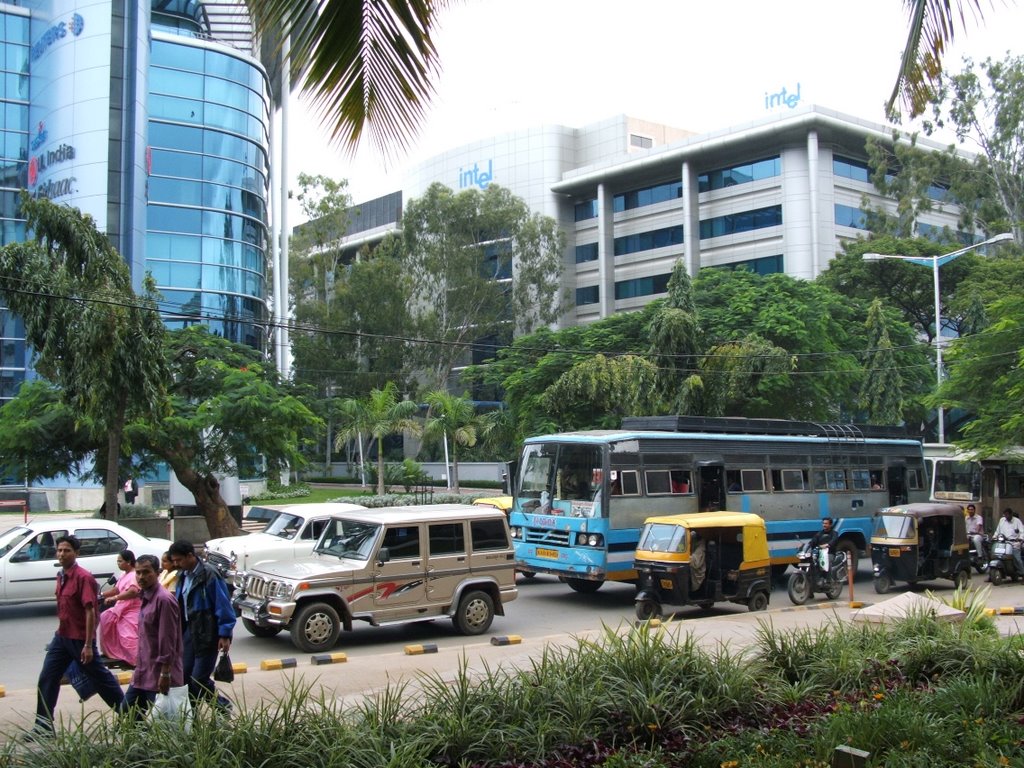
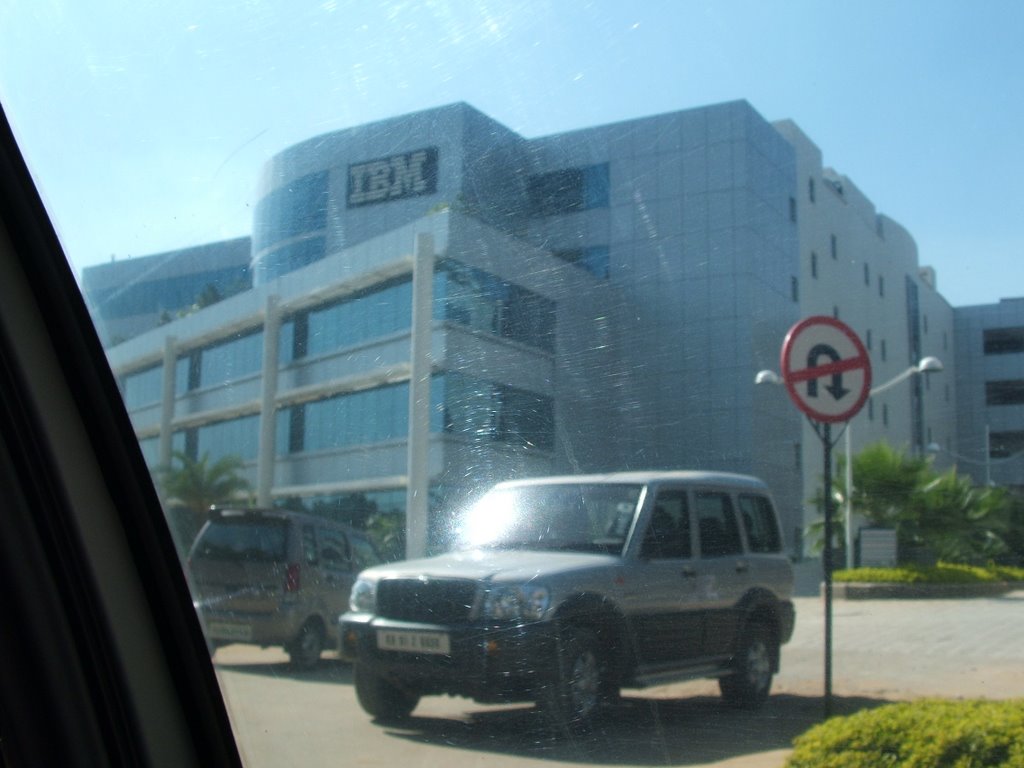
Back in September 2004, I got to make a trip to Bangalore, India. I saw an office building for almost every big-name tech company while I was there. Here's a few samples from my personal photo archives. They aren't great pictures as they were taken through the window of the taxi I was riding in.

First Oracle

  • Next Intel
    IBM
    And finally Microsoft


    Copyright © 2006 by Philip Hartman - All Rights Reserved

    The postings on this site are my own and don't necessarily represent IBM's positions, strategies, or opinions.

Friday, October 13, 2006

A Company that Can Run Itself from Wherever It Makes the Most Business Sense

I found this interesting blurb highlighting the continuing changes in corporate life:

"A job reassignment notice from IBM today signals something more than that another American executive is moving his office halfway round the world. John Paterson, the company's chief procurement officer, is relocating from Somers, N.Y., to Shenzhen in southern China. IBM's (nyse: IBM - news - people ) global procurement division is going with him. It is the first time, the company says, that it has moved a corporatewide headquarters division outside the U.S. Shenzhen sits just north of Hong Kong on the southeastern side of the Pearl River delta.....That shifting global pattern of employment is old news, but that the top-boss job in a key division is relocating marks a milestone along the road of IBM's transition from an American multinational to a global company, one that can run itself from wherever it makes the most business sense. "

Check out: IBM Goes Global - Forbes.com


The postings on this site are my own and don't necessarily represent IBM's positions, strategies, or opinions.


Wednesday, September 06, 2006

Cultural Diversity for I/T Architects

I found myself appreciating Scott Mark's reaction to his first visit to China. I had a similar reaction to India two years ago. Take a look at Application Architecture for the Enterprise: China and the Swarm


"China is amazing in many ways to me. For one thing, it's an incredibly pedestrian society. It's lightweight and limber at the lowest levels. Buildings are literally flying up all around Shanghai, and yet you see the bricks arrive on site via handcart and bicycle basket. I can't imagine the amount of goods in China that are hauled around by individuals rather than machines. Is that inefficient, or the product of a behind society? I don't think so. I think it's amazingly limber and responsive. The West is in the process of trying to discover or re-discover the swarm. China is the swarm."

Wednesday, July 26, 2006

Hot Skills / Cold Skills - What's the Near-Term I/T Future?

I’m sure I am not the only technical professional who has pondered questions like:

  • Are my skills becoming obsolete?
  • Am I becoming too expensive to do the things I’m good at or like to do?
  • What kind of skills do I need to develop to stay gainfully employed? (keep from getting fired - play defense)
  • What kind of skills do I need to thrive in the future? (get promoted - play offense)
I stumbled across a ComputerWorld article by Stacy Collett entitled “Hot Skills, Cold Skills: The IT worker of 2010 won't be a technology guru but rather a 'versatilist.'

In the article she has some interesting quotes such as:
  • “The most sought-after corporate IT workers in 2010 may be those with no deep-seated technical skills at all.”
  • “IT departments will be populated with "versatilists" -- those with a technology background who also know the business sector inside and out, can architect and carry out IT plans that will add business value, and can cultivate relationships both inside and outside the company.”
  • “the skills required to land these future technical roles will be honed outside of IT. Some of these skills will come from artistic talents, math excellence or even a knack for public speaking -- producing a combination of skills not commonly seen in the IT realm.”
Check out the article. I’d love to hear from others about what skills they think it will take to “play offense” and thrive as an I/T Architect in the near future.

Also, for anyone who has had their head in the sand, you may want to see these for a little motivation to consider the future. (hint) Both of these are focused on the latest and greatest SOA technology, not legacy code.

You may also want to check out some of my previous posts which address similar issues related to our changing and evolving careers:

The Globalized I/T Architect

I Really Am a Master Certified I/T Architect

Are All the Good I/T, Science, and Engineering Jobs Going Overseas?

The Role of the Business Transformation Architect

A Culture of Innovation? Or NOT?

How to Become More Creative in Solving Problems

$1 Billion Investment in "Info on Demand"

Are you Pi-shaped?

Epidemic Career Advice

SAP Disrupts Everything

Naming Well, an Essential Skill of an I/T Architect

Vendor-Neutral I/T Architect Certification Program

I/T Architect Certification Revisited

Copyright © 2006 by Philip Hartman - All Rights Reserved

The postings on this site are my own and don't necessarily represent IBM's positions, strategies, or opinions.


Thursday, June 15, 2006

The Globalized I/T Architect

There was a lot of fanfare about the IBM "town hall" in Bangalore, India recently. My teammates in Bangalore all got to attend. Based on the Tuesday morning conference call comments, it was a big hit over there

Sam Palmisano, also had some interesting words in the Financial Times the other day. Basically he said the multi-national corporation is dead ... to be superceded by "the globally integrated enterprise." I have no way of knowing how much of this is truly original thought but I would point his comments out to readers.

All of this globalization has a huge impact on those of us who have to shepherd complex software projects along. The globally dispersed development model is alive and well. I suppose, however, that almost any big company that might move a lot of software work offshore has already done it. So now what happens? What does this mean for us as "high wage country" I/T architects? Here are a few thoughts:

  1. Whether we like it or not our job often become to ensure that the global model chosen by the bosses way above us is succesful. Project sabatoge to get them to change their mind is career suicide.
  2. Our job will be getting even more consultative. We will likely spend even a greater percentage of our time worrying about business requirements.
  3. Our "Soft Skills" become even more important as we spend more time writing, presenting, facilitating, persuading, planning, coordinating, selling our ideas, etc.
  4. We'll focus more and more on the things which must be done face-to-face with the business users, excutives, clients, etc. If you can do your job over a VPN from your home office, beware because the job could probably be done from the other side of the world.
  5. We'll write more documentation than ever before so as to enable the armies of offshore developers to be successful (see #1). More and more we will be successful when we achieve results thru others. (Almost sounds like management doesn't it?)
  6. The offshore teams' work will move "up the food chain" to become more and more strategic. See a URL I've pointed to before, IBM to invest $200 million in Global Business Solution Center. The technical lead for this effort, Ray Harishankar, was recently appointed an IBM Fellow, the highest level a technical person can achieve in IBM. There are only 62 of them today out of over 300,000 IBM employees.

Copyright © 2006 by Philip Hartman - All Rights Reserved


The postings on this site are my own and don't necessarily represent IBM's positions, strategies, or opinions.
Wednesday, November 30, 2005

Hillarious Look at Implications of Outsourcing

I ran across a great article that will really make you think about the concept of outsourcing and the potential impact on ourselves, our work habits, the economy, and the world. You'll get a chuckle reading this very non-technical, non-I/T treatment of outsourcing through the eyes of a magazine editor. Check out My Outsourced Life by A. J. Jacobs of Esquire Magazine. Warning, there is a small amount of off-color language and a bit of male chauvinism, too. Its worth reading and a lot more fun than that the latest thought leadership on business-I/T alignment or J2EE vs. .NET web service compatibilty issues.


The postings on this site are my own and don't necessarily represent IBM's positions, strategies, or opinions.