Tuesday, August 02, 2011

Does anybody know what data SAP Enterprise Services actually expose?

Anybody know where I could get the mapping of SAP database table & field names to data elements in the WSDL of a standard SAP Enterprise Service? It seems our SAP technical consultant is unable to determine this without manually opening up the ABAP code that comes with SAP. The element names in the Enterprise Service are long English names which are quite different from the German acronym-like names of the standard SAP databases that all the SAP functional consultants are familiar with. It seems very painful to figure out what data is actually being exposed by the Enterprise Service.


Copyright © 2011 by Philip Hartman - All Rights Reserved

The postings on this site are my own and don't necessarily represent IBM's positions, strategies, or opinions.

Monday, April 14, 2008

An Unexpected Turn at Management

I have not been nearly as successful at integrating blogging and podcasting back into my life as I wanted after my unreal, fantasy assignment in China ended at the end of October 2007. After the holidays and after some procrastination on my part, I was hit with a reorganization at work. Suddenly I was asked to be a first line manager.

For some people this would have been an exciting event and cause for celebration. But for me it was cause for pause. In some ways I had made a career out of not becoming a manager, a pure sales person, or a project manager. I had managed to advance to a pretty high level on mostly my technical merits, successful projects, and some happy clients who kept signing up for more services based on that success. I was comfortable in a career path that would hopefully get me at least one more promotion some day (soon I hope) to what IBM calls a "Distinguished Engineer." I was to be a mentor but not a real manager.

Now I was asked to officially take over the care and feeding of 14 specialists and architects. Something inside told me that I should say "yes" and give it my best shot. I still want to be a Distinguished Engineer but I think now is the time to grow some other skills which may prove valuable later. In the past, when something unexpected happened in my career it usually turned out to be for the best after all. Visit my other blog if you're curious about my outlook on such things.

Copyright © 2008 by Philip Hartman - All Rights Reserved

The postings on this site are my own and don't necessarily represent IBM's positions, strategies, or opinions.

Tuesday, February 19, 2008

A new breakout of the acronym “SAP” heard today:

SAP = Slow and Painful

Monday, February 11, 2008

International Conference on Global Software Engineering

If you have been a regular reader of my blog, you know that globalization is one of my favorite topics of discussion. Therefore, I would like to draw your attention to the International Conference on Global Software Engineering which will be held August 17-20, 2008 in Bangalore, India. (Recently renamed Bangaluru.) The event is sponsored by the IEEE Computer Society.

Please note that if you have some thoughts to share, there is still time to submit a paper. The deadline for abstracts is Feb 21, 2008 and the deadline for papers is Feb 28, 2008.

Yours truly is a member of the Program Committee for the event. However, that doesn’t mean I automatically get to attend. I still have pay the registration fee and pay to get myself there… or convince my employer of the wisdom of spending their money to send me. I had the good fortune to visit my team in Bangalore and interview a few programmers for positions back in the fall of 2004 and I would certainly enjoy a return trip for the conference. I would be curious have any of you (my readers) had success at securing funding for travel to this kind of thing? If so, I’d love to hear how you justified the expense to your employer.

Copyright © 2008 by Philip Hartman - All Rights Reserved

The postings on this site are my own and don't necessarily represent IBM's positions, strategies, or opinions.

Sunday, February 10, 2008

Do You Use a Dash?

This may be a silly thing, but when you write your job title, do you write it as "I/T Architect" or "IT Architect" ?

I got used to using the slash several years ago. I think that is what I saw most often inside IBM where I work.

However, now it seems that I am seeing the title written without the slash. I noticed that the Open Group certification program uses no slash. (See the Master Certified IT Architect logo on the right side of my blog.)

I'm tempted to abandon the slash. What do you think? Which do you use? Which do you like better?


Copyright © 2008 by Philip Hartman - All Rights Reserved


The postings on this site are my own and don't necessarily represent IBM's positions, strategies, or opinions.

Tennessee Rational User Group

I received an email a while back from Tin Dizdarevic of the Rational User Group looking for a volunteer to lead the Tennessee Rational User Group. After much soul searching and a little procrastination, I decided to raise my hand and take this on.

If any of my readers from Tennessee would like to joint the Tennessee Rational User Group, please go to the Global Rational User Group web site, use the "Find a User Group" feature to search for the chapter in Tennessee, and register for the group.

I am also soliciting suggestions on the best (or least bad) times for the User Group to meet, how often it should meet, where it should meet, and what topics you would like to see addressed.

I'm Back (At Least I Hope So)

I am a little embarrassed at how long it has been since my last post. My project in China was very demanding and when I rolled off that project the end of October I went immediately into the Thanksgiving and Christmas holidays. It was January before I started feeling normal again and by then I was out of the habit. I will try to do better now.

Wednesday, December 19, 2007

Now Podcasting, Too !

One of the things which I learned in China is that many of the young, educated, professional Chinese view having good English language skills as a prerequisite to many of the top jobs in China. Apparently, the best jobs in China all require regular interaction with foreigners like me. I found they were a lot more interested in me helping them with their English than in helping me learn Chinese.

For some reason, I found that many found my voice, cadence, and diction easier to understand than most. (Maybe they were just trying to be nice to me?) Being from Tennessee in the American South, I mentioned this to an American from South Carolina that I met in Beijing. He laughed and told me that "the Chinese love Southerners because we talk slow." Whatever the reason, I took an interest in teaching English and came up with the idea of using a podcast with corresponding transcript to assist my new friends with pronunciation even when I am not around.
Off topic for this blog... but for anyone who might be interested I even got to teach English in a Chinese government-registered church. See My Chinese Church Away from Home.

I decided to start a podcast equivalent to this blog at http://artsciita.podbean.com/. If English is not your native language, I hope you will check it out. This is something of an experiment so if you try it and like it, you had better let me know. It is a little extra work on me and I might lose interest if nobody seems to be paying attention. Here's an online MP3 player with links to share our subscribe to the RSS feed. I went back and added voice for the most popular posts and a few of my personal favorites.

Copyright © 2007 by Philip Hartman - All Rights Reserved


The postings on this site are my own and don't necessarily represent IBM's positions, strategies, or opinions.

Back to the Real World After China

About 6 weeks ago, I completed one of the most challenging 10 months of my entire 26+ year career. I helped create the Enterprise Service Bus for a major Chinese company and during that time I made six trips to China and spent a total of 4.5 months there. I joked with friends that I did not live in the "real world" anymore because I would have never believed that anyone would actually pay me to work in China for so long. I did, however, learn a lot about globally distributed teams, ESB's, SOA, and the culture clash of trying to make people from China, the US, Canada, and India all work together.

In particular, my job was to help integrate their website with 3rd party service providers and their SAP back end. My resume is now full of references to XML, web services, canonical data modeling (XML schemas), WebSphere Message Broker, and WebSphere Process Server.

It was a heady time but I must confess I'm glad its over. It has taken me several weeks to get back into the groove and sit down and take some time to blog again.

Copyright © 2007 by Philip Hartman - All Rights Reserved

The postings on this site are my own and don't necessarily represent IBM's positions, strategies, or opinions.

Tuesday, August 21, 2007

Learn to Love Your SAP IDoc

Over a year ago, I had a post in which I discussed how difficult it is for a custom application development person like myself to get adjusted to projects based on a packaged application like SAP. It had the somewhat humorous title How to Talk to an SAP Consultant (If You Must).

If you keep reading this post, you will see that I am now starting to understand some of the SAP terminology which once seemed so incomprehensible. I hope you will find this post helps accelerate your own understanding of SAP if you are thrust into it like I was.

I now have become all too familiar with the SAP interfaces for external system known by the name "IDoc".

SearchSAP.com provides the following definition:

IDoc (for intermediate document) is a standard data structure for electronic data interchange (EDI) between application programs written for the popular SAP business system or between an SAP application and an external program.
Being relatively new to the SAP world, these complex documents reminded me of database schemas generated by the old Computer-Aided Software Engineering (CASE) tools with many cryptic table names and field names that only an automated tool could keep track of.

For example, suppose you want to create an order from an external system in the Customer Relationship Management (CRM) module of SAP. What would you expect the interface to be called? How about something like "Create Order"? Wrong! My client's CRM team first instructed us to use a standard IDoc going by the rather unintuitive name of "CRMXIF_ORDER_SAVE_M02". Shortly later, they decided that this standard IDoc would not meet all their business requirements and they created a new IDoc from the standard one and gave it a name they prefixed with a "Z" and added a different ending. I will stick with the standard create order IDoc for this post, however.

Ok, suppose you get past that detail, get into the right IDoc and start looking for the data representing the order header. Do you find it under something like "Order Header" or "Order"? No! Try looking for something SAP calls a "segment" and whose name is "E101CRMXIF_BUSTRANS".

help.sap.com has this to say about segments:

Segments form the basic building blocks of an IDoc type and are used to store the actual data.

A segment type is the name of a segment and is independent of the SAP release.

The segment definition is the release-specific name of a segment. By combining the segment type and the release, the required segment definition can be determined: This way, you can assign segment definitions from previous releases to an IDoc type in the current release. This may be necessary if, for example, the partner is using an older release which supports your current IDoc type but not your current segment definitions. You then have to "reset" these in the Structure link Partner profiles .


This segment type name is not completely random but is based on the phrase "business transaction" instead of order. I believe the addition of "E101CRMXIF_" to the beginning makes the segment type release-specific and specifies the segment definition.

Each segment can in turn have multiple fields. Some of these fields can contain data defined by another segment. These can be optional or mandatory. One segment can have a 1:1 or 1:n relationship with another segment. For example, the standard E101CRMXIF_BUSTRANS segment looks like this when I look at it in the XML editor of Rational Software Architect v7 (though truncated to what would display on my screen and still be readable):
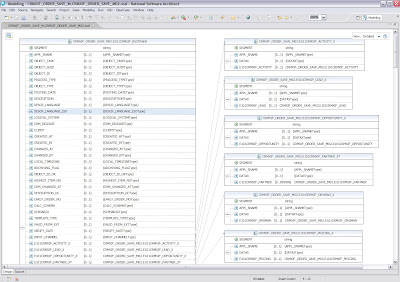

Note that the order segment has many individual elements (mostly strings) followed my many references to other segments. The graphical representation looks a lot like an object model or database design.

An entire SAP IDoc can be huge! The entire IDoc for orders includes well over 200 IDoc segments. After I used my XML editor to format the XML schema of CRMXIF_ORDER_SAVE_M02 so that it was neatly indented and had line feeds before each level of nesting, the resulting XML schema file was a mere 38257 lines long.

If your next project takes you down to the implementation level of SAP, I hope you're a detail-oriented person.

(Dec 2007) English not your native language? I've begun making podcasts of popular posts and they are available at http://artsciita.podbean.com/. Listen online at that URL, with the MP3 player below, or subscribe to the podcast using the RSS feed and listen with your favorite MP3 player.

Copyright © 2007 by Philip Hartman - All Rights Reserved

The postings on this site are my own and don't necessarily represent IBM's positions, strategies, or opinions.

Perils of Over-Customizing SAP-Broken Reports

I've been around clients for some great discussion on the perils of over-customizing SAP lately. I hope to collect some of the lessons learned here for your reading enjoyment and career enrichment.

Here's a comment made by a country sales manager at a meeting I attended in May 2007.
"They told us that the new SAP system would have over 160 reports out-of-the-box that we could use to run our business and we didn't plan on having to create a lot of custom reports. Now they tell us that's not true. Almost all the out-of-the-box reports are broken. Almost every report we need must be a custom development."
It seems this company made some customizations to their base SAP system (ECC) when they were only operating in a only single country and were focused only on a transactional, commodity type business model. They then moved into multiple countries and began to look closely at big, relational customers and value-added services. To support this, they planned to create a new CRM system running on top of their existing ECC. They were not happy to find out that their legacy of prior ECC customizations "broke" a lot of the standard SAP reports.

I'd love to hear from other people who might have an SAP over-customization lesson to share.

(Dec 2007) English not your native language? I've begun making podcasts of popular posts and they are available at http://artsciita.podbean.com/. Listen online at that URL, with the MP3 player below, or subscribe to the podcast using the RSS feed and listen with your favorite MP3 player.


The postings on this site are my own and don't necessarily represent IBM's positions, strategies, or opinions.

Friday, June 01, 2007

Globalization and the Brain Drain

As more than a casual observer of the globalization of technology (I type this from my hotel room in Beijing) I was amused to read the article "China hit by brain drain, report says" in the China Daily provided by the Beijing Hilton. The article made some pretty stark comments about the state of affairs:
  • Since 1978, more than 70% of all Chinese who traveled abroad to study chose not to return home
  • Between 1978 and 2006 about 1.06 million Chinese went to study overseas and just 275,000 returned home.
  • About 300,000 people who went abroad with the initial intention of visiting relatives later enroled in higher education and stayed
  • Chinese students overseas, especially those with extraordinary abilities are a real hit in the global tug of war for talent.
I guess this must be true. After all, why am I here in China? Why do I personally know five IBMers from the US who'll be working here next week?


The postings on this site are my own and don't necessarily represent IBM's positions, strategies, or opinions.

Wednesday, May 30, 2007

Outsourcing to Vietnam

My hotel in Beijing gave me a free copy of The Wall Street Journal Asia yesterday. The cover story got my attention with the title "Vietnam wins attention as new outsourcing hub." The article goes on to explain how companies like Harvey Nash PLC are using Vietnam to service clients such as Belgium's Belgacom SA, Honda Motor Co.'s British unit, Discovery Communications Inc.'s Discovery Channel, and NBC Universal's MSNBC. I did a little poking around on www.ibm.com's site search capability and found that my own employer is active as well. See IBM Press room - 2007-03-12 IBM Expands Global Service Delivery Capabilities - New Centers in China and Vietnam.

So which country is next?

The postings on this site are my own and don't necessarily represent IBM's positions, strategies, or opinions.

Friday, May 25, 2007

On War and Aggessive Project Schedules

I recently attended a 3-day "Business Design Assurance" or BDA held by my client. On the first day it was clear that there were still a lot of unresolved issues and the desired delivery date of the rollout to the first country was a risk. There was a lot of talk along the lines of "we can't go live without XXX!" A certain Senior Vice President could not attend the second day of the BDA but had the following as a message posted on the wall when everyone arrived for the second day of discussion.

"A good plan today violently executed is better than a perfect plan next week!"

General George S. Patton

(Dec 2007) English not your native language? I've begun making podcasts of popular posts and they are available at http://artsciita.podbean.com/. Listen online at that URL, with the MP3 player below, or subscribe to the podcast using the RSS feed and listen with your favorite MP3 player.


Powered by Podbean.com

Wednesday, May 09, 2007

The Global Lifestyle Time Challenge

I had a subtle career milestone today. Today I became fully aware that I was now "Global" ... with a capital "G" I think.

At about 6:30 am Central time I checked email at home before leaving for the airport. I saw an email from a business leader in the UK which set off alarms in my head that an important business decision my client needed to make was not being addressed. Knowing that a politically important deadline is approaching, I fired off a "this is a big issue!" email designed to alarm my readers that something important was not happening.

About 8 am Central time today I was waiting for a flight at the airport and my cell phone went off. It was that same business leader in the UK who took notice of my alarm. I don't know about you, but I don't get cell phone calls from people I've never met from other countries every day.

Shortly after arriving at my destination on the East Coast of the US, I scheduled a web meeting for tomorrow morning between people in Baltimore, Raleigh, California, and Beijing.

Later I was on a call between the US and Canada talking about interfaces to a system in China.

Still later I discussed architecture diagrams showing system components in Rochester (NY), Boulder, Dallas, Tulsa, Phoenix, Hong Kong, Beijing, and Toronto. I tried to figure out if the component in Hong Kong was really necessary. Could it be co-located with the rest of the stuff in Beijing?

I ate a hurried dinner of Tandoori Takki with two co-workers. One is a Norwegian citizen born in China but holding an American green card and the other was born in India but has been working in the US for a while. My history is boring compared to theirs.

Five minutes after checking into my hotel, I joined a conference call between the US and China but the co-worker from China didn't make the call. My co-worker later came online in China on instant messenger later and I pinged him about the call he missed. It turned out he was double booked for that timeslot. Heavy sigh. When are we going to solve time zone issues for calendars? I made sure he had the information for the web meeting in 9 hours.

This globalization thing isn't all its cracked up to be. Exactly when is it I am supposed to have some calm moments to think? When is it I am supposed to get more exercize like my doctor told me? Will the guy in California get up to make the web meeting at 6 am his time? Did I even have a right to call a web meeting that required someone to be there at 6 am? Will the guy in Beijing who has to join at 9 pm his time have a decent Internet connection? Did I have a choice on the time given that the guy we want to talk to was available then and it was a comfortable 9 am for him? Will my flight home on Friday be on time so I can make my daughter's piano recital? How early do I set my alarm clock for tomorrow? Early enough to hit the hotel treadmill or late enough to get another hour of sleep?

I have another trip to China coming up in two weeks. It is still fun for now. I can see how this could get old. I would love to hear how my readers in similar situations are handling the demanding hours, encroachment upon personal time, cultural differences, etc.

FYI, globalization has been a frequent topic of mine. You might take a look at some previous posts such as:


(Dec 2007) English not your native language? I've begun making podcasts of popular posts and they are available at http://artsciita.podbean.com/. Listen online at that URL, with the MP3 player below, or subscribe to the podcast using the RSS feed and listen with your favorite MP3 player.

Copyright © 2007 by Philip Hartman - All Rights Reserved

The postings on this site are my own and don't necessarily represent IBM's positions, strategies, or opinions.

Sunday, April 29, 2007

I'd Rather Be Lucky than Good

This isn't my usual type of post because it talks not about concepts or competence but about a stroke of unusually good professional luck.


I was one of 4700 IBMers attending the Technical Leadership Exchange in Anaheim, California. I had just gotten a new assignment to create the canonical data model for my client's new enterprise service bus (ESB). I think of this as the superset of all the many possible data attributes of the major business objects that flow across the ESB. Examples would include purchase order, order acknowledgement, invoice, advance shipping notice, and more. The back end system for all of these transactions is SAP.


There was some training on Sunday before the conference started on Monday. At dinner Sunday night I sat down at a table of strangers and made some IBM smalltalk with my new acquaintances. A few minutes later some other guys sat down. The guy who sat to my immediate left asked me who I was, where I was from, what I was doing, etc.

When I mentioned I was working on a project to create a canonical data model for an ESB, he casually told me "Oh, I've been working on IBM's canonical data model for IBM's ESB for two years. I'm the lead architect." At this point I just about fell out of my chair. I could not believe my good fortune.


I told him I would pick up his dry cleaning and wash his car if he'd tell me everything he knew about canonical data models. He laughed and offered to help me.


To make a long story short, he wound up showing me the canonical data model for IBM's own ESB and pointed me to where I could download XML schemas off the IBM intranet. Incidentally, IBM uses SAP for many of its back end functions. One valuable tidbit of information included was a spreadsheet linking attributes in the canonical form with specific SAP IDOC segments and fields.


In the consulting business we call this "intellectual capital" and wonderful intellectual capital it is. Obviously, this has really jumpstarted my work. I wish I could say that I was really good but in this case I must confess being really lucky (or have I been living right?... that's another discussion).


He never did make me wash his car either. As we said playing basketball after someone said we were just lucky to make a difficult shot. Luck counts!

Friday, April 20, 2007

Avatars for Architects

There is a yearly conference for IBM's client-facing technical leaders. During the lean years when money was in short supply for training, being selected to attend this event was especially coveted. For a long time, the only way to be guaranteed an invitation was to get selected to speak at the event. Speaker selection became quite competitive.

I am happy to report that after about four years of trying, I actually got to speak at the 2007 Technical Leadership Exchange held in Anaheim, California.

I am a firm believer in sampling something really off-the-wall every now and then to knock the cobwebs off of some unused brain cells. I saw that a favorite speaker of mine, David McDavid, the source for a previous post The Role of the Business Transformation Architect was giving a talk on the business implications of Second Life.

I naively thought that only a few crazies like me would show up for such a thing. Wrong! There must have been 500 of my peers there to check it out. The entire conference was about 4700 people and you had to arrive by 1PM Sunday afternoon to attend the Second Life talk.

As a speaker, I was privy to the pre-registration numbers. When I sorted the 420 or so elective sessions, the Second Life presentation was the one that more of IBM's technical leaders wanted to reserve a seat to attend than any other. At the session I learned IBM is quite a land baron in the Second Life "megaverse," owning many Second Life "islands".

David talked about how he played around in Second Life and found himself wanting to set up his own place and how he intentionally chose a location with interesting neighbors including a small software company and East Coast artist. He raved about all the interesting people he had met thru Second Life. It began to sound like an endorsement of my unoriginal theory that it is good to check out off-the-wall ideas and hang out with interesting people not like me every now and then.

The message to my readers is that smart people are either taking Second Life and the business implications of it very seriously... or they are afraid they aren't taking it seriously enough and might be missing the next big thing.


I decided I must already be behind the curve. If you log into Second Life and find a boy next door looking avatar named Caleb Schumann who doesn't know what he's doing in the megaverse, it is me fumbling around trying to catch with the train that has already left the station without me.


Me over the volcano that is about to errupt and kill me if I don't do the hula for some character on a training island for newbies.
The postings on this site are my own and don't necessarily represent IBM's positions, strategies, or opinions.

Word from the China Front

I had the good fortune to make my second trip to visit my client in Beijing, China. My trip was extended twice and I wound up staying three and a half weeks.

  • The reason my trip got extended was that one of my team's biggest recommendations related to eCommerce was rejected by the client as too expensive and taking too long. Heavy sigh. A worthy competitor has been introduced into the overall solution as a result.
  • I got to observe an interesting phenomenon. When an army of English speaking people fly to China to conduct meetings in English with Chinese I/T staff, the English speakers tend to dominate the discussion while everyone is in the room. The Chinese are generally soft-spoken and before they can mentally translate from English to Chinese, the English speakers move on to the next point. The Chinese are too polite to interrupt and say "you're going too fast." Therefore, the English speakers think there is a consensus only to discover objections later that never got expressed during the meeting.
  • I joined the team tasked with creating an Enterprise Service Bus (ESB) for the client. This ESB must span from North America to China. I think it qualifies as the "Brokered ESB Deployment Pattern" as described in my earlier post ESB Patterns that "Click".
  • I've been learning more about SAP and integrating SAP to other systems.
  • On a personal level unrelated to I/T Architecture, I got to have dinner with a member of Communist Party, to be amazed yet again at the incredible changes taking place in Chinese society, to visit the Summer Palace, to visit the Lama Temple, and take a bicycle rickshaw ride thru an old Beijing hutong. I got really tired of Kung Pao Chicken too.

Me at the Summer Palace in March 2007.

The postings on this site are my own and don't necessarily represent IBM's positions, strategies, or opinions.

Friday, February 23, 2007

When do You Leave a Good Job?

It has been an embarrassingly long time since I’ve posted but I recently made a huge career change and I’ve been pretty busy. I’m afraid blogging dropped off my radar for several weeks. At least it was huge for me. As a consultant, I could change projects and clients without changing employer. Not everyone is that lucky.

Here’s a little history. I was encouraged by my management back in the fall to leave my comfort zone and take on bigger challenges. I think the handwriting was on the wall that I was as high as I could go in the organization if I stayed put. At first it looked like I might become what we call an “Associate Partner” in IBM Global Business Services and take on more of a marketing role. Instead, I wound up taking on an Enterprise Architect role in a truly global project.


Me at the Temple of Heaven, Beijing, China

I did indeed raise my hand and say “Yes” I will leave the position where I was happy, effective, and comfortable. I will leave the position where I got to sleep in my own bed every night and “jump into the frying pan.”


National Software Technology Park - Beijing, China

I knew I wouldn’t be bored. But would I be happy?

This whole experience had led me to think a lot about the question “When is the right time to leave a good job?” This is not an easy question. I think it strikes at the heart of our professional identity. I had to do a lot of soul searching about my priorities. I had to face questions like:

  • What is really important to me?
  • Am I content to stay where I am and continue to do what I’m doing?
  • What is the cost career-wise of staying put?
  • Is it better to leave now on my own terms rather than wait for some executive to make the decision for me by phasing out the position before I’m ready to leave?
  • Is it really possible in today’s global economy to have work-life balance?
  • Is it really possible to “work smarter not harder”?
  • Are there intangible benefits to making a change outside of my career?


If you look at my situation purely from a career point of view, I stayed in my previous position too long. Four years with one client on one major project using technology picked 3 or 4 years ago is too long for a technology professional. There were, however, other considerations such as the whole work-life balance issue. For me the decision to make a change came down these points:

  • I was getting a little bored because I’d been doing almost the same thing for four years.
  • I don’t know if it is healthy ambition or vanity, but I did find myself wanting the professional recognition and reward that came with a bigger, more visible project.
  • I think it is better to get out in front of large trends like globalization on my own terms rather try to hold onto what I’ve got and take the chance it might taken from me before I’m ready. A client once told me “There is an on-coming train coming. I can either put up my hand and try to stop it (and get run over) or try to get on board as the engineer.”
  • Biggest of all for me – the intangible benefits outside of my career. (If you’re brave enough to explore the spiritual side of leaving your comfort zone, click here.)

I’d love to hear what you think about leaving a good position. Have you ever done it? Did you regret it? Or did you never look back?

In case you're wondering how it is going... I'm working harder and working longer hours but I'm having a ball! So for now... it is good!

Click here if you are interested in my commentary and pictures about my recent travels to China. Still more pictures on flickr. Don’t forget Toronto.


Copyright © 2007 by Philip Hartman - All Rights Reserved


The postings on this site are my own and don't necessarily represent IBM's positions, strategies, or opinions.

Friday, January 19, 2007

IBM Labs in Beijing

Here is the entrance to the IBM facility outside the 5th ring of Beijing in the northern suburbs. It contains the IBM Development Lab (off left hand side of picture), the IBM Research Lab (shown on right side), and the IBM SOA Solution Center (straight down the path between the two labs.


Copyright © 2007 by Philip Hartman - All Rights Reserved

The postings on this site are my own and don't necessarily represent IBM's positions, strategies, or opinions.