IBM Labs in Beijing
Copyright © 2007 by Philip Hartman - All Rights Reserved
The postings on this site are my own and don't necessarily represent IBM's positions, strategies, or opinions.
A mix of crisp insight and totally random thoughts on software development, estimating techniques, political influences on technology decisions, technical team building, consulting skills, application development methodology, emerging technology trends, vendor hype, legacy system integration, and everything else that makes a credible I/T Architect and a successful I/T Architect career.
Copyright © 2007 by Philip Hartman - All Rights Reserved
The postings on this site are my own and don't necessarily represent IBM's positions, strategies, or opinions.
Posted by
Philip Hartman
at
8:35 AM
0
comments
Labels: China, Globalization, IBM
I have been able to visit the IBM facility north of Beijing's fifth ring where teh IBM Development Lab and IBM Research Lab are housed. There is also an SOA Solution Center as well. The internet was a lot faster there too compared to the hotel and my client. I've heard again that an earthquake off Taiwan ruined and undersea fiber optick cable and much of Asia is affected. How many of you have redundancy between the US and your global operations to survive an undersea cable break? What would you do if it only was a lot slower vs. broken completely?
Below, my IBM co-workers play a hacky-sak type game at lunch. The software group development lab is to the right, the solution center is straight ahead behind them, and the research lab is to the right side.
Copyright © 2007 by Philip Hartman - All Rights Reserved
The postings on this site are my own and don't necessarily represent IBM's positions, strategies, or opinions.
Posted by
Philip Hartman
at
2:14 AM
0
comments
Labels: China, Disaster Recovery, Globalization, IBM
Anyone who has been a regular visitor to my humble blog has probably noticed that the globalization of software development has been a frequent topic of mine. In particular, I have been heavily involved over the last 3-4 years with software development in India. Whether you or I like it or not, it looks like I am going to continue to be immersed in the topic of globalization. I started a new assignment with a new client recently and this client has very strong ties to China. I could not believe my good fortune when I was given a golden opportunity to travel to China for about two weeks of meetings. Wow! A chance to observe the technology sector in China firsthand! I arrived in China Monday night.
Because of all the language and cultural issues, IBM has made a conscious effort to locate consultants who speak Chinese. Someitmes it seems like every Chinese speaking IBM consultant in the US and Canada is on my project! Not that this is a bad thing either. Its great to be able to hop in a taxis with a co-worker and have a co-worker act as interpreter.
Then around 10 AM this morning "it" happened. My client got passionate about a particular topic and switched from English to Chinese. Within about 10 seconds all my co-workers had joined in the discussions in Chinese too and "it" hit me. I was the only non-Chinese speaker in the room and there were three different Chinese conversations going on. I didn't take it as they were trying to exclude me. I think it was just easier for the client to express their thoughts clearly in their native language. I chose to just let the conversations go on without my interruption. My co-workers updated me later with a summary of their concerns. I have a feeling it won't be the last time either.
If you're interested in reading more about my trip to China, see my posts on China on my "Phil's Folderol" blog.
Copyright © 2007 by Philip Hartman - All Rights Reserved
The postings on this site are my own and don't necessarily represent IBM's positions, strategies, or opinions.
Posted by
Philip Hartman
at
4:46 AM
1 comments
Labels: China, Globalization, Soft Skills
Anyone who has been a regular visitor to my humble blog has probably noticed that the globalization of software development has been a frequent topic of mine. In particular, I have been heavily involved over the last 3-4 years with software development in India. Whether you or I like it or not, it looks like am going to continue to be immersed in the topic of globalization. I started a new assignment with a new client recently and this client has very strong ties to China. I could not believe my good fortune when I was given golden opportunity to travel to China for about two weeks of meetings. Wow! A chance to observe the technology sector in China firsthand!
Because of all the language and cultural issues, IBM has made a conscious effort to locate consultants who speak Chinese. I think every Chinese speaking IBM consultant in the US and Canada is on my project! Not that this is a bad thing. Its great to be able to hop in a taxis with a co-worker and have a co-worker interpreter.
Then around 10 AM or so this morning "it" happened. My client got passionate about a particular topic and switched from English to Chinese. Within about 10 seconds all my co-workers had joined in the discussions in Chinese too and "it" hit me. I was the only non-Chinese speaker in the room and there were three different Chinese conversations going on. I didn't take it as they were trying to exclude me. I think it was just easier for the client to express their thoughts clearly. I chose to just let the conversations go on without my interruption. My co-workers updated me later with a summary of their concerns. I have a feeling it won't be the last time either.
If you're interested in reading more about my trip to China, see my posts on China on my "Phil's Folderol" blog.
Copyright © 2007 by Philip Hartman - All Rights Reserved
The postings on this site are my own and don't necessarily represent IBM's positions, strategies, or opinions.
Posted by
Philip Hartman
at
4:46 AM
0
comments
Labels: Globalization, Soft Skills
I'm not finished yet, but I can already tell that The World is Flat [Updated and Expanded]: A Brief History of the Twenty-first Century
The postings on this site are my own and don't necessarily represent IBM's positions, strategies, or opinions.
Posted by
Philip Hartman
at
5:34 AM
0
comments
Labels: Career, Globalization, Government Regulation, Internet, Leadership, Politics, Quotes, Soft Skills, Supply Chain, Talent
Like most of you, I have marginalized the super computer space as a kniche I'll never play in. I considered that the realm of big government agencies predicting where the next hurricane will strike or modeling the temperature and density of uranium and hydrogen isotopes inside a nuclear bomb 9 nanoseconds after detonation. (Sorry, I read The Sum of All Fears.)
Well... my opinion was changed by an unlikely source yesterday. I stumbled across an investing article by The Motley Fool called "Do the Math: IBM Wins" in which the Fools extol the virtues of IBM as the best blue chip stock of 2007 because of supercomputing.
"I am convinced that IBM is going to be the best blue chip of 2007, but not just because it is a leader in the development and creation of supercomputers. Rather, it is because I believe that IBM's Global Consulting business, working in conjunction with its Center for Business Optimization (whose small staff specializes in applying advanced mathematics to business problems), will be able to first help businesses harness the power of these powerful computers to crunch data and then translate that data into meaningful -- and profitable -- insights."So it appears now I have to consider yet another hardware option in my solutions. I suppose somebody in IBM or Cray or both is selling super computer cycles "on demand" in a hosted environment for anybody who wants to rent one for a millisecond or two. (or is that nanosecond or two?)
"For example, IBM's Center for Business Optimization recently helped a company that had more than 70,000 SKUs (stock keeping units) with an inventory problem. Normally, finding the best way to manage this number of products would have taken six hours. With a supercomputer, it took 17 seconds.What this implies in more practical terms is that the company, instead of waiting overnight for results, now gets them immediately. More importantly, because the results are available immediately, the company can now insert different variables into the program to find an even better way to optimize its inventory."
Copyright © 2006 by Philip Hartman - All Rights Reserved
The postings on this site are my own and don't necessarily represent IBM's positions, strategies, or opinions.
Posted by
Philip Hartman
at
8:55 AM
0
comments
Labels: Architectural Thinking, Hardware, IBM, Super Computing
I didn't even know this was going on until this morning, but apparently several high-tech companies including IBM, Siebel, and Computer Sciences Corp. have settled class action lawsuits regarding overtime pay for technology workers.
"International Business Machines Corp. settled a federal class-action lawsuit Wednesday, agreeing to pay a total of $65 million to 32,000 technology workers who claimed the company illegally withheld overtime pay....The case involved workers classified as "Technical Services Professional and Information Technology Specialists." IBM considered them highly skilled professionals exempt from overtime laws detailed in the Fair Labor Standards Act and California labor laws....Software maker Siebel Systems Inc. settled a class action suit by more than 800 workers earlier this month. The workers, who had job titles such as "software engineer" and "senior software engineer," will receive a total of $27.5 million....Last year, El Segundo-based Computer Sciences Corp. settled an overtime class-action suit by 30,000 employees for $24 million. "For more complete details, see IBM Settles Overtime Lawsuit for $65M.
The postings on this site are my own and don't necessarily represent IBM's positions, strategies, or opinions.
Posted by
Philip Hartman
at
6:03 AM
1 comments
Labels: Career, Government Regulation, IBM, Talent
My eyes were drawn today to an ITBusinessEdge post "Companies that Need SOA the Most Are Least Likely to Implement It". How could I resist that title? (That reminds me of a previous post of mine "Naming Well, an Essential Skill of an I/T Architect" but I degress.) That post in turn drove to yet another cleverly named post
Is SOA success in the genes? by ZDNet's Joe McKendrick -- Todd Biske recently responded to my post about Microsoft's recommended approach to SOA (inch by inch, it's a cinch; mile by mile, its a trial), and ponders whether some organizations can get SOA right away, but others will never get it. How do organizations end up with their IT out of synch with business [...]The basic premise here is worth entertaining. Companies that already have good alignment of I/T and business, already have good governance in place, already think proactively and strategically about I/T, etc. will find moving to a Service Oriented Architecture just the next incremental step in their improvement process. For the other companies out there (the vast majority?), the gap between where they are today and SOA is an insurmountable chasm that they dare not even try to cross.
Posted by
Philip Hartman
at
11:20 AM
0
comments
Labels: Anti-Patterns, Architectural Thinking, Funding, Leadership, Lessons Learned, Politics, Risk, SOA
Judging by the unexpectedly large number of hits on my recent posting about reverse engineering Java into UML diagrams, I am not the only one interested in this topic. Along the same lines, I found this pretty cool demo of reverse engineering UML sequence diagrams from Sparx Systems. I haven't actually used the tool but what appears to be different with the reverse engineering capability of their Enterprise Architect tool is that it will generate diagrams via runtime execution. It also let you manually step through your code as it executes in a debugger type presentation. This would let you control how far “down in the weeds” you want your sequence diagram to go. For example, do you really want to include that call to the Integer class?
(Dec 2007) English not your native language? I've begun making podcasts of popular posts and they are available at http://artsciita.podbean.com/. Listen online at that URL, with the MP3 player below, or subscribe to the podcast using the RSS feed and listen with your favorite MP3 player.
The postings on this site are my own and don't necessarily represent IBM's positions, strategies, or opinions.
Posted by
Philip Hartman
at
11:09 AM
1 comments
Labels: Object Modeling, Reverse Engineering, UML
I've taken an interest (by necessity) in the globalization of software development (and corporate life in general) so I read with interest "Bill Gates Says West Not Supplying Enough IT Talent" by James Kilner of Reuters. Bill Gates was speaking in Moscow and is quoted as follows:
"Worldwide, a lot of the developed countries are not graduating as many IT students as they were in the past, which is kind of ironic as it does mean it does increase the opportunities."If you follow the link above to the story about Gates and look at comments posted at the bottom, they were mostly bemoaning the fact that I/T jobs in places like Russia, China, and India pay a lot less than the US and other Western nations. They attributed the "shortage" to a shortage of people willing to work for low wages.
"There is a shortage of IT skills on a worldwide basis. Anybody who can get those skills here now will have a lot of opportunity."
"It's all about business model innovation—giving clients the ability to rapidly change business models by building applications with reusable software components," said Sudhir Sastry, leader of the IBM SOA Solutions Center, in Pune.
Key to the initiative is IBM's WebSphere Business Services Fabric—based on technology IBM recently acquired when it purchased Webify Solutions, Sastry said.
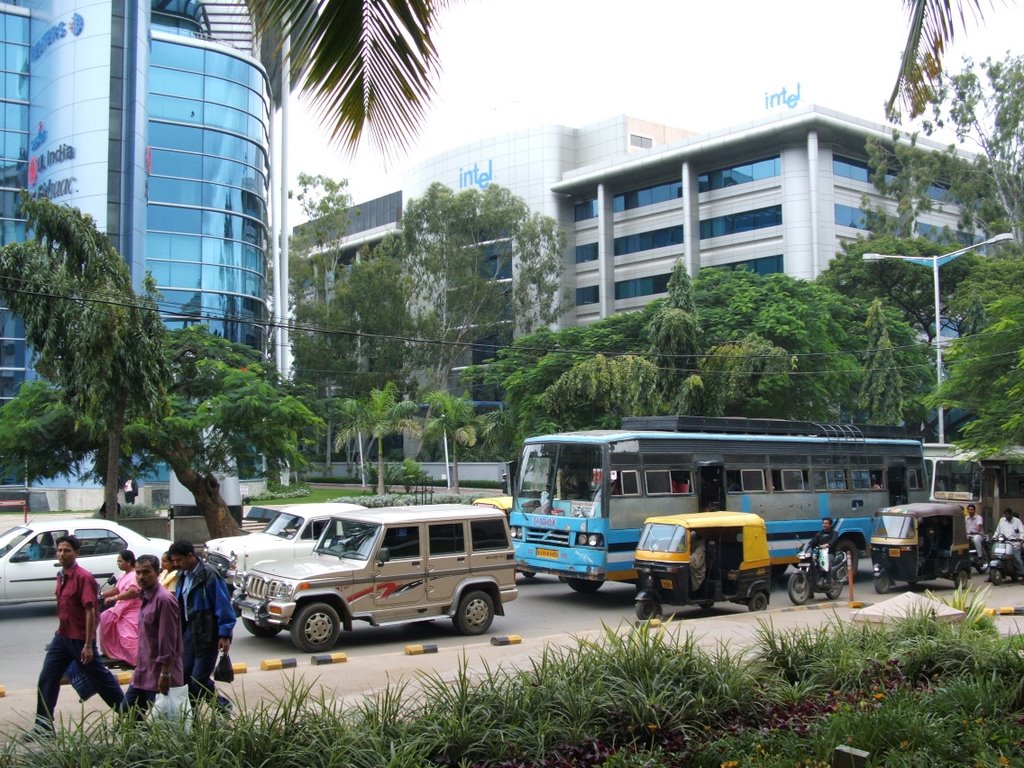
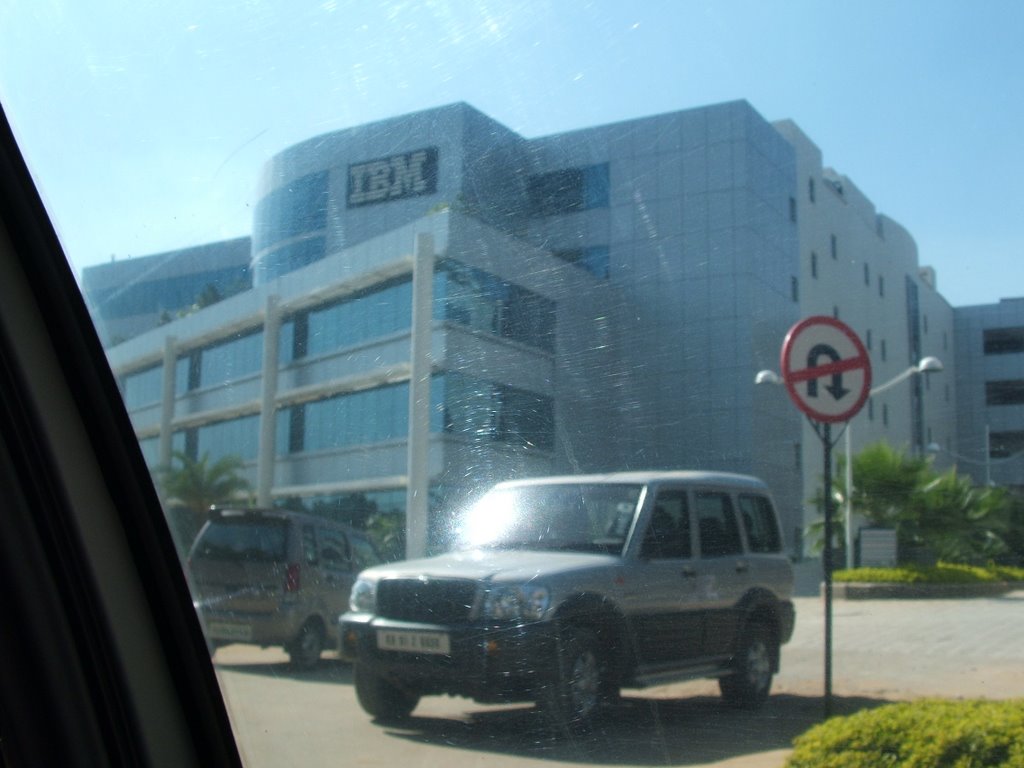
Back in September 2004, I got to make a trip to Bangalore, India. I saw an office building for almost every big-name tech company while I was there. Here's a few samples from my personal photo archives. They aren't great pictures as they were taken through the window of the taxi I was riding in.
Posted by
Philip Hartman
at
7:24 PM
1 comments
Labels: Globalization, SOA, Talent
You've really got to view this new commercial showing how wireless technology can be a game changer in retail. See "The Future Market" (a play on words.. think super market).
Copyright © 2006 by Philip Hartman - All Rights Reserved
The postings on this site are my own and don't necessarily represent IBM's positions, strategies, or opinions.
Brenda Michelson has some clever variations on the acronym SOA in her post Talking "S-O-A" with the Business.
Some of my favorites from her post include:
The postings on this site are my own and don't necessarily represent IBM's positions, strategies, or opinions.
Posted by
Philip Hartman
at
5:29 PM
0
comments
For your Halloween reading pleasure: Check out Little Shop of (IT) Horrors.
The postings on this site are my own and don't necessarily represent IBM's positions, strategies, or opinions.
Posted by
Philip Hartman
at
11:25 AM
0
comments
Labels: Lessons Learned
About a year ago I had to stop work on an interesting project. There were just too many projects going on at one time, not enough resources to work on them all, and the other projects were more important from a political point of view. The project involved our B2B application making a call to a service provided by a 3rd party outside the firewall. One of the developers had built some great Java code to do this right before we stopped work.
I recently picked that project back up again and needed to dig into that code, understand how it worked, and create some design documentation for the overall project. I also had just recently made a conscious effort to upgrade my object modeling tool from Rational XDE to Rational Software Architect (RSA).
I decided I would start by reverse engineering the Java code to create a class diagram. I had done this numerous times as a Rational Rose and Rational XDE user in the past so I had no worries. I managed to import the source code and began fumbling through the menu options looking for reverse engineering features. I got a sinking feeling at first that someone at Rational had taken the reverse engineering features away. I found numerous transformations for forward engineering from UML class diagrams into something else (like Java). It was not obvious, however, what to do if I already had the Java code and wanted to go in the reverse direction. I had a sinking feeling inside. Had the Model Driven Development / Model Driven Architecture adherents at Rational lost their minds? Had they taken those reverse engineering features away on purpose? Was this a heavy handed means of forcing the whole world to adopt a “forward engineering only” view of the application development process?
Luckily, I was able to determine that Rational had not lost its collective mind. Yes, it was indeed possible to reverse engineer code into a diagram and as I got more into it, I decided it was actually an improvement.
I highly recommend a meaty white paper I found on developerWorks called “The new IBM Rational design and construction products for Rose and XDE users” by William T. Smith, a Product Manager supporting model driven development at IBM Rational brand software. From it I discovered that many reverse engineering capabilities were available in RSA (as well as Rational Software Modeler (RSM)) and they appear to be significant improvements over what I was used to in Rose and XDE. There is a great deal of new terminology to get used to, however.
Here is a quick summary of what I learned about reverse engineering using RSA
Together, these reverse engineering capabilities will just about take away the last excuses for not having design documentation match the “as implemented” state of the Java code. It really is easy to create both class and sequence diagrams and rapidly document both the static and dynamic behavior of “as is” Java software.
(Dec 2007) English not your native language? I've begun making podcasts of popular posts and they are available at http://artsciita.podbean.com/. Listen online at that URL, with the MP3 player below, or subscribe to the podcast using the RSS feed and listen with your favorite MP3 player.
The postings on this site are my own and don't necessarily represent IBM's positions, strategies, or opinions.
Posted by
Philip Hartman
at
8:41 PM
6
comments
Labels: Object Modeling, Rational Tools, Reverse Engineering, UML
Out of the many emails I get from the various online trade rags, one jumped out at me from my inbasket the other day. The email pointed me to one article with a title inspired by the upcoming Halloween season: 25 Terrifying Information Technology Horror Stories. There's even a great video clip from an old black and white horror movie, "The Brain that Wouldn't Die".
Copyright © 2006 by Philip Hartman - All Rights Reserved
The postings on this site are my own and don't necessarily represent IBM's positions, strategies, or opinions.
Posted by
Philip Hartman
at
7:25 PM
0
comments
Labels: Lessons Learned, PM, Risk
Not all I/T Architect-bloggers are as fortunate as I in that my employer actually encourages us to blog. (See my very first post in this blog.) I'll reproduce a quote from the IBM employee blogging guidelines I quoted back then. "It is very much in IBM's interest – and, we believe, in each IBMer's own – to be aware of this sphere of information, interaction and idea exchange."
Obviously, not all corporations embrace this kind of thinking. Dan Gillmore points out two very different scenarios in " Corporate Blogging: What Could Go Wrong? The first is the obvious concern about someone leaking new product information and potentially giving a competitor an early start on catching up. But the second scenario was more interesting. It was about the cost of NOT using blogging and NOT being clear and transparent about problems in the open media. He makes an interesting point about not getting out in front of "bad news" and actually engaging potential customers in solving the problem.
"The real danger is not letting your employees harness the full power of an interactive, edge-in communications medium. If you keep the reins too tight, you won't reap the benefits of informed and passionate readers and users. And sometimes, if you're not communicating freely with your readers and users, bad news can catch them by surprise."I have to admit I see his logic... especially in the area of product development. If I was trying to come up with the next generation Apple iPod I am sure I could recruit an army of passionate bloggers to help me. But what if client A has a whole bunch of fuzzy business requirements, a hodge-podge of technology accumualted from their merger history, and a minefield of political considerations. How would a crowd on the outside be able to digest all the client-specific nuances of the situation? And would the client even want their client-specific details out in the open?
The postings on this site are my own and don't necessarily represent IBM's positions, strategies, or opinions.
Posted by
Philip Hartman
at
7:06 PM
3
comments
Labels: blogging, innovation
"At Railinc Corp., a transportation logistics firm based in Cary, N.C., Garry Grandlienard, director of enterprise architecture, notes that many of his company's applications draw on certain basic information about railcars, stored in one main database. Before SOA, changing one element of that database might have meant changing 100 applications. With SOA in place, he may not need to make any application changes at all, since he can change the service layer and it will translate the database change for all applications.Farmington Hills, Mich.-based RouteOne LLC is an exchange established by the finance arms of General Motors Corp., Ford Motor Co., DaimlerChrysler AG and Toyota Motor Corp. to provide auto dealers with access to a variety of financing options and services. Here, SOA gives CIO Joel Gruber a cost-effective way to make changes to his internal infrastructure without disrupting all the firms that use the exchange. In August, RouteOne began piloting an electronic contract feature, called eContracts, to allow auto dealers to forego paper contracts. Key to the eContracts pilot is a service the company built to test its messaging environment. At RouteOne, a transaction, such as an auto loan application, is treated as a type of message, and the testing environment lets the company see if new message types will cause any problems. "It doesn't sound like a service," notes Gruber. "But it's a utility service that means we don't break anything for our customers when we change something.."
Check out:Getting Good Service
Posted by
Philip Hartman
at
6:48 PM
0
comments
Labels: IBM, SOA, Success Stories
I found this interesting blurb highlighting the continuing changes in corporate life:
"A job reassignment notice from IBM today signals something more than that another American executive is moving his office halfway round the world. John Paterson, the company's chief procurement officer, is relocating from Somers, N.Y., to Shenzhen in southern China. IBM's (nyse: IBM - news - people ) global procurement division is going with him. It is the first time, the company says, that it has moved a corporatewide headquarters division outside the U.S. Shenzhen sits just north of Hong Kong on the southeastern side of the Pearl River delta.....That shifting global pattern of employment is old news, but that the top-boss job in a key division is relocating marks a milestone along the road of IBM's transition from an American multinational to a global company, one that can run itself from wherever it makes the most business sense. "Check out: IBM Goes Global - Forbes.com
Posted by
Philip Hartman
at
8:00 AM
0
comments
Labels: Globalization, IBM, Procurement, SOA
I present this little bit of anecdotal evidence that employment prospects for I/T professionals here in the USA are bright. I am making my first college recruiting trip! I will be interviewing undergraduates and graduate students at the University of Tennessee at Knoxville on October 27, 2006 October 20, 2006 for positions in IBM Global Business Services-Application Services. We’ve been hiring experienced professionals all along for several years but this is my first personal experience interviewing college students for entry level positions. I like to look at it as hiring the next generation of I/T Architects and others who will become the technical leaders of tomorrow. Think about it. This is a clear indication of confidence in our future prospects for new business and demonstrates a willingness to invest in the training and mentoring of new employees who don't have lots of real-world experience.
I was actually on campus a couple of weeks ago to speak at an "info night" to talk about Application services and what career in consulting is like. Here's a picture of the UT University Center.
Posted by
Philip Hartman
at
7:48 PM
0
comments