Tuesday, December 12, 2006

Fortune Favors the Prepared Mind

I'm not finished yet, but I can already tell that The World is Flat [Updated and Expanded]: A Brief History of the Twenty-first Century is going to be one of those books which is going to havea great impact on my professional life. There is so much truth (I don't have to like the truth) in the information presented, I was motivated to shoot an email to almost everyone in my email address book to recommend the book to them as a way to prepare for the impact of globalization on their life and careers.

The email had "Fortune Favors the Prepared Mind" as the subject line and read as follows:

A friend of mine recommended The World is Flat [Updated and Expanded]: A Brief History of the Twenty-first Century to me as a great book on the impact of globalization. I'm only about 20% done with it (the audio version) but I think there is a lot of good material on outsourcing, offshoring, India, China, etc. which I believe would benefit each of you as you think the future and the kinds of opportunities we all probably need to prepare for.

See also some great quotes from the book at www.wikiquote.org.

Some samples:

Every morning in Africa, a gazelle wakes up.
It knows it must run faster than the fastest lion or it will be killed.
Every morning a lion wakes up.
It knows it must outrun the slowest gazelle or it will starve to death.
It doesn’t matter whether you are a lion or a gazelle.
When the sun comes up, you better start running.
-African proverb

• In the pathbreaking 1989 essay, “Computer and Dynamo: the Modern Productivity Paradox in a Not-Too Distant Mirror,” the economic historian Paul A. David explained such a lag by pointing to a historical precedent. He noted that while the lightbulb was invented in 1879, it took several decades for electrification to kick in and have a big economic and productivity impact. Why? Because it was not enough just to install electric motors and scrap the old technology – steam engines. The whole way of doing manufacturing had to be reconfigured. In the case of electricity, David pointed out, the key breakthrough was in how buildings, and assembly lines, were designed and managed. Factories in the steam age tended to be heavy, costly multistory buildings designed to brace the weighty belts and other big transmission devices needed to drive steam-powered systems. Once small, powerful electric motors were introduced, everyone hoped for a quick productivity boost. It took time, though. To get all the savings, you needed to redesign enough buildings with small electric motors powering machines of all sizes. Only when there was a critical mass of experienced factory architects and electrical engineers and managers, who understood the complementarities among the production line, did electrification really deliver the productivity breakthrough in manufacturing, David wrote.

Bill Gates: 30 years ago, if you had a choice between being born a genius on the outskirts of Bombay or Shanghai or being born an average person in Poughkeepsie, you would take Poughkeepsie, because your chances of thriving and living a decent life there, even with average talent, were much greater. But as the world has gone flat, and so many people can plug and play from anywhere, natural talent has started to trump geography.

• America integrated a broken Europe and Japan into the global economy after World War II, with both Europe and Japan every year upgrading their manufacturing, knowledge, and service skills, often importing and sometimes stealing ideas and equipment from the US, just as America did from Britain in the late 1770s. Yet in the sixty years since World War II, our standard of living has increased every decade, and our unemployment rate – even with all the outcry about outsourcing – stands at only a little above 5 percent, roughly half that of the most developed countries in Western Europe.

• By automating these jobs, it enables companies to save money and free up talented brainpower from relatively mundane tasks to start new businesses in other areas. You should be afraid of free markets only if you believe that you will never need new medicines, new work flow software, new industries, new forms of entertainment, new coffeehouses.

• It takes a leap of faith, based on economics, to say there will be new things to do. But there always have been new jobs to do, and there is no fundamental reason to believe the future will be different. Some 150 years ago, 90 percent of American worked in agriculture and related fields. Today, it’s only 3 or 4 percent. What if the government had decided to protect and subsidize all those agricultural jobs and not embrace industrialization and then computerization? Would America as a whole really be better off today? Hardly.

• Well, here’s the truth that no one wanted to tell you: The world has been flattened. As a result of the triple convergence, global collaboration and competition – between individuals and individuals, companies and individuals, companies and companies, and companies and customers – have been made cheaper, easier, more friction-free, and more productive for more people from more corners of the earth than at any time in the history of the world.

• The sense that our kids have to be swaddled in cotton wool so that nothing bad or disappointing or stressful ever happens to them at school is, quite simply, a growing cancer on American society.

• In China today, Bill Gates is Britney Spears. In America today, Britney Spears is Britney Spears – and that is our problem.

• As exciting and as visible as the flat Indian high-tech sector is, have no illusions: It accounts for 0.2 percent of employment in India. Add those Indians involved in manufacturing for export, and you get a total of 2 percent of the employment in India.

• Immigrants are always hungry and they don’t have a backup plan. Young Chinese, Indians, and Poles are not racing us to the bottom. They are racing us to the top. They do not want to work for us; they don’t even want to be us. They want to dominate us.

• The best companies outsource to win, not to shrink. They outsource to innovate faster and more cheaply in order to grow larger, gain market share, and hire more and different specialists – not to save money by firing more people. (p. 360)

• The business organization consultant Michael Hummer once remarked, “One thing that tells me a company is in trouble is when they tell me how good they were in the past. Same with countries. You don’t want to forget your identity. I am glad you were great in the 14th century, but that was then and this is now. When memories exceed dreams, the end is near. The hallmark of a truly successful organization is the willingness to abandon what made it successful and start fresh.

• People don’t change when you tell them there is a better option. They change when they conclude that they have no other option.

• Louis Pasteur said it a long time ago: “Fortune favors the prepared mind.”


The postings on this site are my own and don't necessarily represent IBM's positions, strategies, or opinions.

Wednesday, November 29, 2006

Supercomputers, Not Just for Chess, Weather, and Nuclear Bombs?

Like most of you, I have marginalized the super computer space as a kniche I'll never play in. I considered that the realm of big government agencies predicting where the next hurricane will strike or modeling the temperature and density of uranium and hydrogen isotopes inside a nuclear bomb 9 nanoseconds after detonation. (Sorry, I read The Sum of All Fears.)

Well... my opinion was changed by an unlikely source yesterday. I stumbled across an investing article by The Motley Fool called "Do the Math: IBM Wins" in which the Fools extol the virtues of IBM as the best blue chip stock of 2007 because of supercomputing.

"I am convinced that IBM is going to be the best blue chip of 2007, but not just because it is a leader in the development and creation of supercomputers. Rather, it is because I believe that IBM's Global Consulting business, working in conjunction with its Center for Business Optimization (whose small staff specializes in applying advanced mathematics to business problems), will be able to first help businesses harness the power of these powerful computers to crunch data and then translate that data into meaningful -- and profitable -- insights."

"For example, IBM's Center for Business Optimization recently helped a company that had more than 70,000 SKUs (stock keeping units) with an inventory problem. Normally, finding the best way to manage this number of products would have taken six hours. With a supercomputer, it took 17 seconds.

What this implies in more practical terms is that the company, instead of waiting overnight for results, now gets them immediately. More importantly, because the results are available immediately, the company can now insert different variables into the program to find an even better way to optimize its inventory."

So it appears now I have to consider yet another hardware option in my solutions. I suppose somebody in IBM or Cray or both is selling super computer cycles "on demand" in a hosted environment for anybody who wants to rent one for a millisecond or two. (or is that nanosecond or two?)

Copyright © 2006 by Philip Hartman - All Rights Reserved

The postings on this site are my own and don't necessarily represent IBM's positions, strategies, or opinions.

Monday, November 27, 2006

Overtime Pay for I/T Architects?

I didn't even know this was going on until this morning, but apparently several high-tech companies including IBM, Siebel, and Computer Sciences Corp. have settled class action lawsuits regarding overtime pay for technology workers.
"International Business Machines Corp. settled a federal class-action lawsuit Wednesday, agreeing to pay a total of $65 million to 32,000 technology workers who claimed the company illegally withheld overtime pay....The case involved workers classified as "Technical Services Professional and Information Technology Specialists." IBM considered them highly skilled professionals exempt from overtime laws detailed in the Fair Labor Standards Act and California labor laws....Software maker Siebel Systems Inc. settled a class action suit by more than 800 workers earlier this month. The workers, who had job titles such as "software engineer" and "senior software engineer," will receive a total of $27.5 million....Last year, El Segundo-based Computer Sciences Corp. settled an overtime class-action suit by 30,000 employees for $24 million. "
For more complete details, see IBM Settles Overtime Lawsuit for $65M.

I don't plan on spending the money until I see it in my bank account. :-)

Copyright © 2006 by Philip Hartman - All Rights Reserved

The postings on this site are my own and don't necessarily represent IBM's positions, strategies, or opinions.

Wednesday, November 22, 2006

Companies that Need SOA the Most Are Least Likely to Implement It

My eyes were drawn today to an ITBusinessEdge post "Companies that Need SOA the Most Are Least Likely to Implement It". How could I resist that title? (That reminds me of a previous post of mine "Naming Well, an Essential Skill of an I/T Architect" but I degress.) That post in turn drove to yet another cleverly named post

Is SOA success in the genes? by ZDNet's Joe McKendrick -- Todd Biske recently responded to my post about Microsoft's recommended approach to SOA (inch by inch, it's a cinch; mile by mile, its a trial), and ponders whether some organizations can get SOA right away, but others will never get it. How do organizations end up with their IT out of synch with business [...]

The basic premise here is worth entertaining. Companies that already have good alignment of I/T and business, already have good governance in place, already think proactively and strategically about I/T, etc. will find moving to a Service Oriented Architecture just the next incremental step in their improvement process. For the other companies out there (the vast majority?), the gap between where they are today and SOA is an insurmountable chasm that they dare not even try to cross.

I think there is an element of truth. I've seen a lot of situations where a company could benefit from new approaches but because they organize a bunch of independently funded, tactical projects no one project can fund the leap to the next level of maturity and flexibility. (See also "The Scourge of the I/T Architect's Universe".) Just a couple of weeks ago an acquanitance of mine at a major manufacturer told me he was interested in using SOA software products for their EAI-like-middleware value but he didn't think his organization was ready to embrace SOA yet. I guess this is like "flying under the radar" to wait until the political situation is more receptive to SOA.

Copyright © 2006 by Philip Hartman - All Rights Reserved


The postings on this site are my own and don't necessarily represent IBM's positions, strategies, or opinions.

Tuesday, November 14, 2006

Still More on Reverse Engineering Code into UML Diagams

Judging by the unexpectedly large number of hits on my recent posting about reverse engineering Java into UML diagrams, I am not the only one interested in this topic. Along the same lines, I found this pretty cool demo of reverse engineering UML sequence diagrams from Sparx Systems. I haven't actually used the tool but what appears to be different with the reverse engineering capability of their Enterprise Architect tool is that it will generate diagrams via runtime execution. It also let you manually step through your code as it executes in a debugger type presentation. This would let you control how far “down in the weeds” you want your sequence diagram to go. For example, do you really want to include that call to the Integer class?

(Dec 2007) English not your native language? I've begun making podcasts of popular posts and they are available at http://artsciita.podbean.com/. Listen online at that URL, with the MP3 player below, or subscribe to the podcast using the RSS feed and listen with your favorite MP3 player.


Copyright © 2006 by Philip Hartman - All Rights Reserved

The postings on this site are my own and don't necessarily represent IBM's positions, strategies, or opinions.

Thursday, November 09, 2006

Musings on Bill Gates, the IT Shortage, and Globalization

I've taken an interest (by necessity) in the globalization of software development (and corporate life in general) so I read with interest "Bill Gates Says West Not Supplying Enough IT Talent" by James Kilner of Reuters. Bill Gates was speaking in Moscow and is quoted as follows:

"Worldwide, a lot of the developed countries are not graduating as many IT students as they were in the past, which is kind of ironic as it does mean it does increase the opportunities."

"There is a shortage of IT skills on a worldwide basis. Anybody who can get those skills here now will have a lot of opportunity."
If you follow the link above to the story about Gates and look at comments posted at the bottom, they were mostly bemoaning the fact that I/T jobs in places like Russia, China, and India pay a lot less than the US and other Western nations. They attributed the "shortage" to a shortage of people willing to work for low wages.

I was probably as nervous as anyone else about the globalization of software development a few years ago. Since then I guess I gotten past my fears. On my best days, I have embraced the idea. On my worst days, I guess I just try to make the best of it.

It does appear to me that CIOs are taking the cost savings of global resourcing and using it to fund additional projects. If they had a budget 5 years ago to do 4 major projects a year then today they are using a similar budget to execute 5, 6, or even 7 major projects. These "extra" projects are often the ones that are the most fun to work on. They would have been "stretch" projects that never got funded in the past. One change that has happened, however, is that those of us in the US are having to play more of a leadership role vs. doing the "heads down" coding.

Another anecdotal piece of evidence that the sky is not falling. I've done some interviewing right here in the US for college graduates. Are we taking just anybody? No, we are being selective. But this is quite an improvement over just a few years ago. We're hiring both overseas and in the "high wage" countries.

By the way, see the Oct 31st article "IBM Plants New SOA Development Centers in India, China" to see that this trend is only accelerating. This is not about using global resources to maintain old code. This is about investments in the latest and greatest SOA technology... and doing it with talent from around the world.

"It's all about business model innovation—giving clients the ability to rapidly change business models by building applications with reusable software components," said Sudhir Sastry, leader of the IBM SOA Solutions Center, in Pune.

Key to the initiative is IBM's WebSphere Business Services Fabric—based on technology IBM recently acquired when it purchased Webify Solutions, Sastry said.

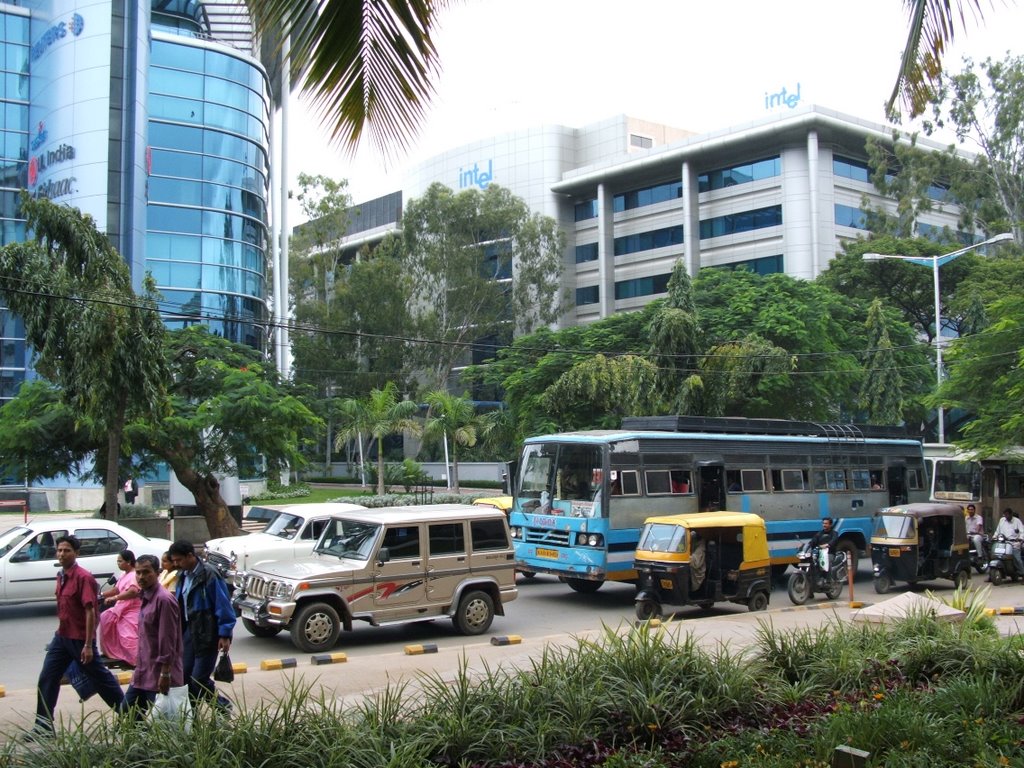
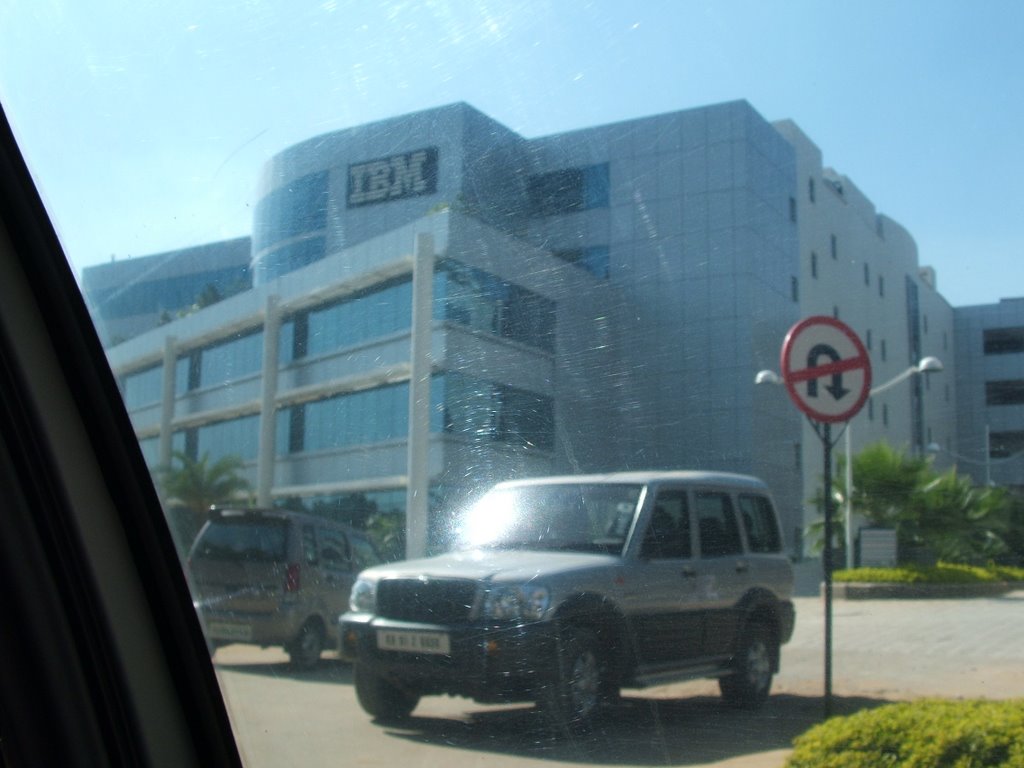
Back in September 2004, I got to make a trip to Bangalore, India. I saw an office building for almost every big-name tech company while I was there. Here's a few samples from my personal photo archives. They aren't great pictures as they were taken through the window of the taxi I was riding in.

First Oracle

  • Next Intel
    IBM
    And finally Microsoft


    Copyright © 2006 by Philip Hartman - All Rights Reserved

    The postings on this site are my own and don't necessarily represent IBM's positions, strategies, or opinions.

Wednesday, November 08, 2006

The Future Market

You've really got to view this new commercial showing how wireless technology can be a game changer in retail. See "The Future Market" (a play on words.. think super market).

I've been told the commercial is actually pretty old but I don't ever remember seeing it. Maybe IBM needs to try using it again.

Copyright © 2006 by Philip Hartman - All Rights Reserved


The postings on this site are my own and don't necessarily represent IBM's positions, strategies, or opinions.

Friday, November 03, 2006

Silo-ed Organization Abolishment and Other Variations on the SOA Theme

Brenda Michelson has some clever variations on the acronym SOA in her post Talking "S-O-A" with the Business.

Some of my favorites from her post include:

  • Strategy Offering Agility
  • Stream of Acronyms
  • Seizing Operational Agility
  • Silo-ed Organization Abolishment

The postings on this site are my own and don't necessarily represent IBM's positions, strategies, or opinions.

Tuesday, October 31, 2006

Little Shop of IT horrors

For your Halloween reading pleasure: Check out Little Shop of (IT) Horrors.

The postings on this site are my own and don't necessarily represent IBM's positions, strategies, or opinions.

Monday, October 30, 2006

Reverse Engineering of UML Class and Sequence Diagrams from Java

About a year ago I had to stop work on an interesting project. There were just too many projects going on at one time, not enough resources to work on them all, and the other projects were more important from a political point of view. The project involved our B2B application making a call to a service provided by a 3rd party outside the firewall. One of the developers had built some great Java code to do this right before we stopped work.

I recently picked that project back up again and needed to dig into that code, understand how it worked, and create some design documentation for the overall project. I also had just recently made a conscious effort to upgrade my object modeling tool from Rational XDE to Rational Software Architect (RSA).

I decided I would start by reverse engineering the Java code to create a class diagram. I had done this numerous times as a Rational Rose and Rational XDE user in the past so I had no worries. I managed to import the source code and began fumbling through the menu options looking for reverse engineering features. I got a sinking feeling at first that someone at Rational had taken the reverse engineering features away. I found numerous transformations for forward engineering from UML class diagrams into something else (like Java). It was not obvious, however, what to do if I already had the Java code and wanted to go in the reverse direction. I had a sinking feeling inside. Had the Model Driven Development / Model Driven Architecture adherents at Rational lost their minds? Had they taken those reverse engineering features away on purpose? Was this a heavy handed means of forcing the whole world to adopt a “forward engineering only” view of the application development process?

Luckily, I was able to determine that Rational had not lost its collective mind. Yes, it was indeed possible to reverse engineer code into a diagram and as I got more into it, I decided it was actually an improvement.

I highly recommend a meaty white paper I found on developerWorks called “The new IBM Rational design and construction products for Rose and XDE users” by William T. Smith, a Product Manager supporting model driven development at IBM Rational brand software. From it I discovered that many reverse engineering capabilities were available in RSA (as well as Rational Software Modeler (RSM)) and they appear to be significant improvements over what I was used to in Rose and XDE. There is a great deal of new terminology to get used to, however.

Here is a quick summary of what I learned about reverse engineering using RSA

  • I can select Java classes of interest with my mouse and quickly reverse engineer a class diagram by “visualizing” a “Topic Diagram”. This diagram can be synchronized with code as the code is modified.
  • I can “harvest” classes from the topic diagram and paste them into a separate UML diagram.
  • I can mix “pure” UML classes and harvested classes on the same diagram and the tool will mark classes reverse engineered from code with a glyph in the upper left hand corner.
  • There is a new “Browse Diagram” capability which allows the user to explore existing code by quickly generating class diagrams “on the fly” showing classes related to a selected class. Selecting a different class on this diagram will generated yet another diagram on the fly with all classes related to that class. This quick navigation from one diagram to another is a great way to “get to know” code someone else wrote. You can control which kinds of relationships are included when the class diagrams are created and how many levels (up to 3) removed from the selected class in the center of the diagram. I made great use of this on my project.
  • (Drum roll please!) I can reverse engineer Java method bodies into UML Sequence Diagrams by “visualizing” a “Static Method Sequence Diagram.” This type of program understanding tool has long been missing from UML modeling tools. It will be a windfall to any poor soul who must maintain/modify poorly documented Java code created by someone else who is perhaps no longer around. The only downside is that if the method makes any calls to low-level Java classes like “Integer” those method calls will clutter the generated diagram. But.. think of the time you’ll save!

Together, these reverse engineering capabilities will just about take away the last excuses for not having design documentation match the “as implemented” state of the Java code. It really is easy to create both class and sequence diagrams and rapidly document both the static and dynamic behavior of “as is” Java software.

(Dec 2007) English not your native language? I've begun making podcasts of popular posts and they are available at http://artsciita.podbean.com/. Listen online at that URL, with the MP3 player below, or subscribe to the podcast using the RSS feed and listen with your favorite MP3 player.


Copyright © 2006 by Philip Hartman - All Rights Reserved
The postings on this site are my own and don't necessarily represent IBM's positions, strategies, or opinions.

Tuesday, October 17, 2006

Halloween Horror Stories for I/T

Out of the many emails I get from the various online trade rags, one jumped out at me from my inbasket the other day. The email pointed me to one article with a title inspired by the upcoming Halloween season: 25 Terrifying Information Technology Horror Stories. There's even a great video clip from an old black and white horror movie, "The Brain that Wouldn't Die".

I won't say I've read through all of the horror stories but from what I can tell, the lessons learned are worth a visit by any serious I/T Architect, project manager, CTO, CIO, and anyone else who doesn't want to be pointed out to the whole world as an example of how NOT to execute an important project.

Copyright © 2006 by Philip Hartman - All Rights Reserved

The postings on this site are my own and don't necessarily represent IBM's positions, strategies, or opinions.

What Could Possibly Be Wrong With Corporate Blogging?

Not all I/T Architect-bloggers are as fortunate as I in that my employer actually encourages us to blog. (See my very first post in this blog.) I'll reproduce a quote from the IBM employee blogging guidelines I quoted back then. "It is very much in IBM's interest – and, we believe, in each IBMer's own – to be aware of this sphere of information, interaction and idea exchange."

Obviously, not all corporations embrace this kind of thinking. Dan Gillmore points out two very different scenarios in " Corporate Blogging: What Could Go Wrong? The first is the obvious concern about someone leaking new product information and potentially giving a competitor an early start on catching up. But the second scenario was more interesting. It was about the cost of NOT using blogging and NOT being clear and transparent about problems in the open media. He makes an interesting point about not getting out in front of "bad news" and actually engaging potential customers in solving the problem.

"The real danger is not letting your employees harness the full power of an interactive, edge-in communications medium. If you keep the reins too tight, you won't reap the benefits of informed and passionate readers and users. And sometimes, if you're not communicating freely with your readers and users, bad news can catch them by surprise."
I have to admit I see his logic... especially in the area of product development. If I was trying to come up with the next generation Apple iPod I am sure I could recruit an army of passionate bloggers to help me. But what if client A has a whole bunch of fuzzy business requirements, a hodge-podge of technology accumualted from their merger history, and a minefield of political considerations. How would a crowd on the outside be able to digest all the client-specific nuances of the situation? And would the client even want their client-specific details out in the open?

Still...I've heard of the popular business book, The Wisdom of Crowds: Why the Many Are Smarter Than the Few and How Collective Wisdom Shapes Business, Economies, Societies and Nations devoted to the innovative use of ideas from outside the company. I haven't read it yet, but maybe I need to. I'd be curious to hear if any of my readers have had success in using blogging to make better one-of-a-kind solutions for clients.

The postings on this site are my own and don't necessarily represent IBM's positions, strategies, or opinions.


Getting Good Service from SOA

You may find this article interesting regarding benefits being realized by Service Oriented Architecture (SOA). The author makes a point to reference many different companies and give some highlightes of their experiences. Here's a couple of samples:
"At Railinc Corp., a transportation logistics firm based in Cary, N.C., Garry Grandlienard, director of enterprise architecture, notes that many of his company's applications draw on certain basic information about railcars, stored in one main database. Before SOA, changing one element of that database might have meant changing 100 applications. With SOA in place, he may not need to make any application changes at all, since he can change the service layer and it will translate the database change for all applications.

Farmington Hills, Mich.-based RouteOne LLC is an exchange established by the finance arms of General Motors Corp., Ford Motor Co., DaimlerChrysler AG and Toyota Motor Corp. to provide auto dealers with access to a variety of financing options and services. Here, SOA gives CIO Joel Gruber a cost-effective way to make changes to his internal infrastructure without disrupting all the firms that use the exchange. In August, RouteOne began piloting an electronic contract feature, called eContracts, to allow auto dealers to forego paper contracts. Key to the eContracts pilot is a service the company built to test its messaging environment. At RouteOne, a transaction, such as an auto loan application, is treated as a type of message, and the testing environment lets the company see if new message types will cause any problems. "It doesn't sound like a service," notes Gruber. "But it's a utility service that means we don't break anything for our customers when we change something.."

Check out:Getting Good Service
The postings on this site are my own and don't necessarily represent IBM's positions, strategies, or opinions.

Friday, October 13, 2006

A Company that Can Run Itself from Wherever It Makes the Most Business Sense

I found this interesting blurb highlighting the continuing changes in corporate life:

"A job reassignment notice from IBM today signals something more than that another American executive is moving his office halfway round the world. John Paterson, the company's chief procurement officer, is relocating from Somers, N.Y., to Shenzhen in southern China. IBM's (nyse: IBM - news - people ) global procurement division is going with him. It is the first time, the company says, that it has moved a corporatewide headquarters division outside the U.S. Shenzhen sits just north of Hong Kong on the southeastern side of the Pearl River delta.....That shifting global pattern of employment is old news, but that the top-boss job in a key division is relocating marks a milestone along the road of IBM's transition from an American multinational to a global company, one that can run itself from wherever it makes the most business sense. "

Check out: IBM Goes Global - Forbes.com


The postings on this site are my own and don't necessarily represent IBM's positions, strategies, or opinions.


Sunday, October 08, 2006

College Hiring

I present this little bit of anecdotal evidence that employment prospects for I/T professionals here in the USA are bright. I am making my first college recruiting trip! I will be interviewing undergraduates and graduate students at the University of Tennessee at Knoxville on October 27, 2006 October 20, 2006 for positions in IBM Global Business Services-Application Services. We’ve been hiring experienced professionals all along for several years but this is my first personal experience interviewing college students for entry level positions. I like to look at it as hiring the next generation of I/T Architects and others who will become the technical leaders of tomorrow. Think about it. This is a clear indication of confidence in our future prospects for new business and demonstrates a willingness to invest in the training and mentoring of new employees who don't have lots of real-world experience.

I was actually on campus a couple of weeks ago to speak at an "info night" to talk about Application services and what career in consulting is like. Here's a picture of the UT University Center.

Monday, September 18, 2006

De-Nerding Your Geeks

It seems that everywhere I am reading another article in some trade rag about the need for technology people to have "soft skills" and be able to communicate with non-techies. Here's a quote from a particularly good example that I stumbled across from the Australian version of www.cio.com. It goes so far as to quote one frustrated CIO who said 'Forget the technology skills, give me business skills and I'll teach them the technology'.
"I don't know what exactly happened, but when the program director came back he was very concerned about the project. I had expected him to be pleased," Setty, now chairman and chief evangelist for US-based Cignex Technologies, says. "I asked him what he was concerned about."

It turned out that program director had asked programmer whether he could make some changes to the program, and if so, how long they would take. Programmer, thrilled at this unexpected chance to flaunt his ability, had launched into an elaborate rundown of the work involved. As a result, program director got intricate details of child and parent windows and other jargon the intensely non-technical director could only translate as gobbledygook. That led program director to two misguided but deeply disturbing conclusions: the team was doing something like rocket science, and there was great strife ahead. "I asked him for a simple change. Now it looks like it will take three days and there is a risk to the project," the program director complained to Setty.

Setty soothed program director's ruffled feathers and assured him his team could indeed make the changes with little risk. That left program director with just one question: "Are you sure you've got the right team for the job?"

Of course, hardly anyone sees today's CIOs as geeks: most CIOs long ago discarded their white socks and sandals for the business suits that gave them passage to the executive suite. But the best laid plans of CIOs can and do often "gang" astray when the geeks who work for them slip their restraints and rub shoulders with - and the sensitivities of - non-geeks of influence within the organization.

Too Many Egos, Too Little Time

"My organization has plenty of people with massive egos that need to be soothed," says one CIO. "If they're having trouble with the computer I can't send some punk into the office who mumbles, won't look them in the eye and grunts, or next thing I know they're on the phone saying: 'I'd like to be treated with respect. I tried talking to him but he couldn't even be bothered answering me'."

So having expelled every last shred of geek-hood from their own bearing, CIOs must now find ways to start purging any symptoms of same from their staff.

"One of the biggest things that geeks have to learn is how to communicate with a non-geek," Setty says. "It's so important. The reason is, the budget most of the time lies with the person who is not a geek: it's with the CFO or a line of business manager. Typically at that level IT staff can't go down to the details of how exactly the software works. These managers just switch off if the geek starts explaining why this 'thing' happens," he says.

Many CIOs have become so sensitive to these difficulties that finding IT staff with business skills is becoming a major preoccupation, says Gartner Executive Programs managing vice president Mary-Anne Maxwell. "CIOs know IT staff need those business skills, and it's getting to the point that a lot of them are now saying to me: 'Forget the technology skills, give me business skills and I'll teach them the technology'. Over the long run that is more important than hiring a person who has a particular outlook on a technology that day."

For more fun reading, check out: CIO | De-nerding Your Geeks

Thursday, September 14, 2006

Microsoft Patent Non-Assertion Covenant for Web Services

Interesting post by David Berlind at Microsoft patent non-assertion covenant is remarkable | Between the Lines | ZDNet.com

"Microsoft has issued a declaration — something it calls the Open Specification Promise — that it won't assert certain Web services patents it holds (or may hold in the future). Martin Lamonica reports:

Microsoft is pledging not to assert its patents pertaining to nearly three dozen Web services specifications–a move designed to ease concerns among developers by creating a legal environment more friendly to open-source software….The software giant published on Tuesday the Microsoft Open Specification Promise (OSP) on its Web site."


Thursday, September 07, 2006

Living on the Bleeding Edge for Fun and Profit

"Let’s start by acknowledging that bleeding-edge has negative connotations for a lot of people. Just think for a minute about the imagery. Bleeding edge evokes danger. ....Engage in that battle, and you might survive, but you’ll get bloodied in the process. ....But my conversation with a couple of IT executives has me thinking about an alternative vision for the bleeding edge.....until you start messing around with new stuff, you can’t answer the question about whether it might provide a competitive advantage or suggest a new business model.....The implication here is that even a company that is uncomfortable adopting a new technology until someone else works out the bugs can’t really afford to wait to check it out. The bleeding-edge might be your competitive edge. And it starts to look smart, rather than dangerous."


Death of the Packaged Application?

Judith Hurwitz says that SOA could result in the end of packaged applications as we know them. Check out SOA and Unintended Market Consequences - Weigh In - weighin - CIO

SOA Anti-Patterns

I stumbled across this article in developerWorks which was very timely for me. The antipattern I'm most worried about right now in my current project is "Chatty Services". I can see how it would be very easy to "fall into this trap" if we try to implement the same level of application-to-application interactivity as we currently enjoy between a user and a web page. Check out SOA antipatterns by Jenny Ang, Luba Cherbakov, and Mamdouh Ibrahim.