Wednesday, May 30, 2007

Outsourcing to Vietnam

My hotel in Beijing gave me a free copy of The Wall Street Journal Asia yesterday. The cover story got my attention with the title "Vietnam wins attention as new outsourcing hub." The article goes on to explain how companies like Harvey Nash PLC are using Vietnam to service clients such as Belgium's Belgacom SA, Honda Motor Co.'s British unit, Discovery Communications Inc.'s Discovery Channel, and NBC Universal's MSNBC. I did a little poking around on www.ibm.com's site search capability and found that my own employer is active as well. See IBM Press room - 2007-03-12 IBM Expands Global Service Delivery Capabilities - New Centers in China and Vietnam.

So which country is next?

The postings on this site are my own and don't necessarily represent IBM's positions, strategies, or opinions.

Friday, May 25, 2007

On War and Aggessive Project Schedules

I recently attended a 3-day "Business Design Assurance" or BDA held by my client. On the first day it was clear that there were still a lot of unresolved issues and the desired delivery date of the rollout to the first country was a risk. There was a lot of talk along the lines of "we can't go live without XXX!" A certain Senior Vice President could not attend the second day of the BDA but had the following as a message posted on the wall when everyone arrived for the second day of discussion.

"A good plan today violently executed is better than a perfect plan next week!"

General George S. Patton

(Dec 2007) English not your native language? I've begun making podcasts of popular posts and they are available at http://artsciita.podbean.com/. Listen online at that URL, with the MP3 player below, or subscribe to the podcast using the RSS feed and listen with your favorite MP3 player.


Powered by Podbean.com

Wednesday, May 09, 2007

The Global Lifestyle Time Challenge

I had a subtle career milestone today. Today I became fully aware that I was now "Global" ... with a capital "G" I think.

At about 6:30 am Central time I checked email at home before leaving for the airport. I saw an email from a business leader in the UK which set off alarms in my head that an important business decision my client needed to make was not being addressed. Knowing that a politically important deadline is approaching, I fired off a "this is a big issue!" email designed to alarm my readers that something important was not happening.

About 8 am Central time today I was waiting for a flight at the airport and my cell phone went off. It was that same business leader in the UK who took notice of my alarm. I don't know about you, but I don't get cell phone calls from people I've never met from other countries every day.

Shortly after arriving at my destination on the East Coast of the US, I scheduled a web meeting for tomorrow morning between people in Baltimore, Raleigh, California, and Beijing.

Later I was on a call between the US and Canada talking about interfaces to a system in China.

Still later I discussed architecture diagrams showing system components in Rochester (NY), Boulder, Dallas, Tulsa, Phoenix, Hong Kong, Beijing, and Toronto. I tried to figure out if the component in Hong Kong was really necessary. Could it be co-located with the rest of the stuff in Beijing?

I ate a hurried dinner of Tandoori Takki with two co-workers. One is a Norwegian citizen born in China but holding an American green card and the other was born in India but has been working in the US for a while. My history is boring compared to theirs.

Five minutes after checking into my hotel, I joined a conference call between the US and China but the co-worker from China didn't make the call. My co-worker later came online in China on instant messenger later and I pinged him about the call he missed. It turned out he was double booked for that timeslot. Heavy sigh. When are we going to solve time zone issues for calendars? I made sure he had the information for the web meeting in 9 hours.

This globalization thing isn't all its cracked up to be. Exactly when is it I am supposed to have some calm moments to think? When is it I am supposed to get more exercize like my doctor told me? Will the guy in California get up to make the web meeting at 6 am his time? Did I even have a right to call a web meeting that required someone to be there at 6 am? Will the guy in Beijing who has to join at 9 pm his time have a decent Internet connection? Did I have a choice on the time given that the guy we want to talk to was available then and it was a comfortable 9 am for him? Will my flight home on Friday be on time so I can make my daughter's piano recital? How early do I set my alarm clock for tomorrow? Early enough to hit the hotel treadmill or late enough to get another hour of sleep?

I have another trip to China coming up in two weeks. It is still fun for now. I can see how this could get old. I would love to hear how my readers in similar situations are handling the demanding hours, encroachment upon personal time, cultural differences, etc.

FYI, globalization has been a frequent topic of mine. You might take a look at some previous posts such as:


(Dec 2007) English not your native language? I've begun making podcasts of popular posts and they are available at http://artsciita.podbean.com/. Listen online at that URL, with the MP3 player below, or subscribe to the podcast using the RSS feed and listen with your favorite MP3 player.

Copyright © 2007 by Philip Hartman - All Rights Reserved

The postings on this site are my own and don't necessarily represent IBM's positions, strategies, or opinions.

Sunday, April 29, 2007

I'd Rather Be Lucky than Good

This isn't my usual type of post because it talks not about concepts or competence but about a stroke of unusually good professional luck.


I was one of 4700 IBMers attending the Technical Leadership Exchange in Anaheim, California. I had just gotten a new assignment to create the canonical data model for my client's new enterprise service bus (ESB). I think of this as the superset of all the many possible data attributes of the major business objects that flow across the ESB. Examples would include purchase order, order acknowledgement, invoice, advance shipping notice, and more. The back end system for all of these transactions is SAP.


There was some training on Sunday before the conference started on Monday. At dinner Sunday night I sat down at a table of strangers and made some IBM smalltalk with my new acquaintances. A few minutes later some other guys sat down. The guy who sat to my immediate left asked me who I was, where I was from, what I was doing, etc.

When I mentioned I was working on a project to create a canonical data model for an ESB, he casually told me "Oh, I've been working on IBM's canonical data model for IBM's ESB for two years. I'm the lead architect." At this point I just about fell out of my chair. I could not believe my good fortune.


I told him I would pick up his dry cleaning and wash his car if he'd tell me everything he knew about canonical data models. He laughed and offered to help me.


To make a long story short, he wound up showing me the canonical data model for IBM's own ESB and pointed me to where I could download XML schemas off the IBM intranet. Incidentally, IBM uses SAP for many of its back end functions. One valuable tidbit of information included was a spreadsheet linking attributes in the canonical form with specific SAP IDOC segments and fields.


In the consulting business we call this "intellectual capital" and wonderful intellectual capital it is. Obviously, this has really jumpstarted my work. I wish I could say that I was really good but in this case I must confess being really lucky (or have I been living right?... that's another discussion).


He never did make me wash his car either. As we said playing basketball after someone said we were just lucky to make a difficult shot. Luck counts!

Friday, April 20, 2007

Avatars for Architects

There is a yearly conference for IBM's client-facing technical leaders. During the lean years when money was in short supply for training, being selected to attend this event was especially coveted. For a long time, the only way to be guaranteed an invitation was to get selected to speak at the event. Speaker selection became quite competitive.

I am happy to report that after about four years of trying, I actually got to speak at the 2007 Technical Leadership Exchange held in Anaheim, California.

I am a firm believer in sampling something really off-the-wall every now and then to knock the cobwebs off of some unused brain cells. I saw that a favorite speaker of mine, David McDavid, the source for a previous post The Role of the Business Transformation Architect was giving a talk on the business implications of Second Life.

I naively thought that only a few crazies like me would show up for such a thing. Wrong! There must have been 500 of my peers there to check it out. The entire conference was about 4700 people and you had to arrive by 1PM Sunday afternoon to attend the Second Life talk.

As a speaker, I was privy to the pre-registration numbers. When I sorted the 420 or so elective sessions, the Second Life presentation was the one that more of IBM's technical leaders wanted to reserve a seat to attend than any other. At the session I learned IBM is quite a land baron in the Second Life "megaverse," owning many Second Life "islands".

David talked about how he played around in Second Life and found himself wanting to set up his own place and how he intentionally chose a location with interesting neighbors including a small software company and East Coast artist. He raved about all the interesting people he had met thru Second Life. It began to sound like an endorsement of my unoriginal theory that it is good to check out off-the-wall ideas and hang out with interesting people not like me every now and then.

The message to my readers is that smart people are either taking Second Life and the business implications of it very seriously... or they are afraid they aren't taking it seriously enough and might be missing the next big thing.


I decided I must already be behind the curve. If you log into Second Life and find a boy next door looking avatar named Caleb Schumann who doesn't know what he's doing in the megaverse, it is me fumbling around trying to catch with the train that has already left the station without me.


Me over the volcano that is about to errupt and kill me if I don't do the hula for some character on a training island for newbies.
The postings on this site are my own and don't necessarily represent IBM's positions, strategies, or opinions.

Word from the China Front

I had the good fortune to make my second trip to visit my client in Beijing, China. My trip was extended twice and I wound up staying three and a half weeks.

  • The reason my trip got extended was that one of my team's biggest recommendations related to eCommerce was rejected by the client as too expensive and taking too long. Heavy sigh. A worthy competitor has been introduced into the overall solution as a result.
  • I got to observe an interesting phenomenon. When an army of English speaking people fly to China to conduct meetings in English with Chinese I/T staff, the English speakers tend to dominate the discussion while everyone is in the room. The Chinese are generally soft-spoken and before they can mentally translate from English to Chinese, the English speakers move on to the next point. The Chinese are too polite to interrupt and say "you're going too fast." Therefore, the English speakers think there is a consensus only to discover objections later that never got expressed during the meeting.
  • I joined the team tasked with creating an Enterprise Service Bus (ESB) for the client. This ESB must span from North America to China. I think it qualifies as the "Brokered ESB Deployment Pattern" as described in my earlier post ESB Patterns that "Click".
  • I've been learning more about SAP and integrating SAP to other systems.
  • On a personal level unrelated to I/T Architecture, I got to have dinner with a member of Communist Party, to be amazed yet again at the incredible changes taking place in Chinese society, to visit the Summer Palace, to visit the Lama Temple, and take a bicycle rickshaw ride thru an old Beijing hutong. I got really tired of Kung Pao Chicken too.

Me at the Summer Palace in March 2007.

The postings on this site are my own and don't necessarily represent IBM's positions, strategies, or opinions.

Friday, February 23, 2007

When do You Leave a Good Job?

It has been an embarrassingly long time since I’ve posted but I recently made a huge career change and I’ve been pretty busy. I’m afraid blogging dropped off my radar for several weeks. At least it was huge for me. As a consultant, I could change projects and clients without changing employer. Not everyone is that lucky.

Here’s a little history. I was encouraged by my management back in the fall to leave my comfort zone and take on bigger challenges. I think the handwriting was on the wall that I was as high as I could go in the organization if I stayed put. At first it looked like I might become what we call an “Associate Partner” in IBM Global Business Services and take on more of a marketing role. Instead, I wound up taking on an Enterprise Architect role in a truly global project.


Me at the Temple of Heaven, Beijing, China

I did indeed raise my hand and say “Yes” I will leave the position where I was happy, effective, and comfortable. I will leave the position where I got to sleep in my own bed every night and “jump into the frying pan.”


National Software Technology Park - Beijing, China

I knew I wouldn’t be bored. But would I be happy?

This whole experience had led me to think a lot about the question “When is the right time to leave a good job?” This is not an easy question. I think it strikes at the heart of our professional identity. I had to do a lot of soul searching about my priorities. I had to face questions like:

  • What is really important to me?
  • Am I content to stay where I am and continue to do what I’m doing?
  • What is the cost career-wise of staying put?
  • Is it better to leave now on my own terms rather than wait for some executive to make the decision for me by phasing out the position before I’m ready to leave?
  • Is it really possible in today’s global economy to have work-life balance?
  • Is it really possible to “work smarter not harder”?
  • Are there intangible benefits to making a change outside of my career?


If you look at my situation purely from a career point of view, I stayed in my previous position too long. Four years with one client on one major project using technology picked 3 or 4 years ago is too long for a technology professional. There were, however, other considerations such as the whole work-life balance issue. For me the decision to make a change came down these points:

  • I was getting a little bored because I’d been doing almost the same thing for four years.
  • I don’t know if it is healthy ambition or vanity, but I did find myself wanting the professional recognition and reward that came with a bigger, more visible project.
  • I think it is better to get out in front of large trends like globalization on my own terms rather try to hold onto what I’ve got and take the chance it might taken from me before I’m ready. A client once told me “There is an on-coming train coming. I can either put up my hand and try to stop it (and get run over) or try to get on board as the engineer.”
  • Biggest of all for me – the intangible benefits outside of my career. (If you’re brave enough to explore the spiritual side of leaving your comfort zone, click here.)

I’d love to hear what you think about leaving a good position. Have you ever done it? Did you regret it? Or did you never look back?

In case you're wondering how it is going... I'm working harder and working longer hours but I'm having a ball! So for now... it is good!

Click here if you are interested in my commentary and pictures about my recent travels to China. Still more pictures on flickr. Don’t forget Toronto.


Copyright © 2007 by Philip Hartman - All Rights Reserved


The postings on this site are my own and don't necessarily represent IBM's positions, strategies, or opinions.

Friday, January 19, 2007

IBM Labs in Beijing

Here is the entrance to the IBM facility outside the 5th ring of Beijing in the northern suburbs. It contains the IBM Development Lab (off left hand side of picture), the IBM Research Lab (shown on right side), and the IBM SOA Solution Center (straight down the path between the two labs.


Copyright © 2007 by Philip Hartman - All Rights Reserved

The postings on this site are my own and don't necessarily represent IBM's positions, strategies, or opinions.

Thursday, January 18, 2007

More Fiber in Your Diet / IBMers at Play

I have been able to visit the IBM facility north of Beijing's fifth ring where teh IBM Development Lab and IBM Research Lab are housed. There is also an SOA Solution Center as well. The internet was a lot faster there too compared to the hotel and my client. I've heard again that an earthquake off Taiwan ruined and undersea fiber optick cable and much of Asia is affected. How many of you have redundancy between the US and your global operations to survive an undersea cable break? What would you do if it only was a lot slower vs. broken completely?

Below, my IBM co-workers play a hacky-sak type game at lunch. The software group development lab is to the right, the solution center is straight ahead behind them, and the research lab is to the right side.


Copyright © 2007 by Philip Hartman - All Rights Reserved

The postings on this site are my own and don't necessarily represent IBM's positions, strategies, or opinions.

Wednesday, January 17, 2007

Off to China

Anyone who has been a regular visitor to my humble blog has probably noticed that the globalization of software development has been a frequent topic of mine. In particular, I have been heavily involved over the last 3-4 years with software development in India. Whether you or I like it or not, it looks like I am going to continue to be immersed in the topic of globalization. I started a new assignment with a new client recently and this client has very strong ties to China. I could not believe my good fortune when I was given a golden opportunity to travel to China for about two weeks of meetings. Wow! A chance to observe the technology sector in China firsthand! I arrived in China Monday night.

Because of all the language and cultural issues, IBM has made a conscious effort to locate consultants who speak Chinese. Someitmes it seems like every Chinese speaking IBM consultant in the US and Canada is on my project! Not that this is a bad thing either. Its great to be able to hop in a taxis with a co-worker and have a co-worker act as interpreter.

Then around 10 AM this morning "it" happened. My client got passionate about a particular topic and switched from English to Chinese. Within about 10 seconds all my co-workers had joined in the discussions in Chinese too and "it" hit me. I was the only non-Chinese speaker in the room and there were three different Chinese conversations going on. I didn't take it as they were trying to exclude me. I think it was just easier for the client to express their thoughts clearly in their native language. I chose to just let the conversations go on without my interruption. My co-workers updated me later with a summary of their concerns. I have a feeling it won't be the last time either.

If you're interested in reading more about my trip to China, see my posts on China on my "Phil's Folderol" blog.

Copyright © 2007 by Philip Hartman - All Rights Reserved


The postings on this site are my own and don't necessarily represent IBM's positions, strategies, or opinions.

Anyone who has been a regular visitor to my humble blog has probably noticed that the globalization of software development has been a frequent topic of mine. In particular, I have been heavily involved over the last 3-4 years with software development in India. Whether you or I like it or not, it looks like am going to continue to be immersed in the topic of globalization. I started a new assignment with a new client recently and this client has very strong ties to China. I could not believe my good fortune when I was given golden opportunity to travel to China for about two weeks of meetings. Wow! A chance to observe the technology sector in China firsthand!

Because of all the language and cultural issues, IBM has made a conscious effort to locate consultants who speak Chinese. I think every Chinese speaking IBM consultant in the US and Canada is on my project! Not that this is a bad thing. Its great to be able to hop in a taxis with a co-worker and have a co-worker interpreter.

Then around 10 AM or so this morning "it" happened. My client got passionate about a particular topic and switched from English to Chinese. Within about 10 seconds all my co-workers had joined in the discussions in Chinese too and "it" hit me. I was the only non-Chinese speaker in the room and there were three different Chinese conversations going on. I didn't take it as they were trying to exclude me. I think it was just easier for the client to express their thoughts clearly. I chose to just let the conversations go on without my interruption. My co-workers updated me later with a summary of their concerns. I have a feeling it won't be the last time either.

If you're interested in reading more about my trip to China, see my posts on China on my "Phil's Folderol" blog.

Copyright © 2007 by Philip Hartman - All Rights Reserved


The postings on this site are my own and don't necessarily represent IBM's positions, strategies, or opinions.

Anyone who has been a regular visitor to my humble blog has probably noticed that the globalization of software development has been a frequent topic of mine. In particular, I have been heavily involved over the last 3-4 years with software development in India. Whether you or I like it or not, it looks like am going to continue to be immersed in the topic of globalization. I started a new assignment with a new client recently and this client has very strong ties to China. I could not believe my good fortune when I was given golden opportunity to travel to China for about two weeks of meetings. Wow! A chance to observe the technology sector in China firsthand!

Because of all the language and cultural issues, IBM has made a conscious effort to locate consultants who speak Chinese. I think every Chinese speaking IBM consultant in the US and Canada is on my project! Not that this is a bad thing. Its great to be able to hop in a taxis with a co-worker and have a co-worker interpreter.

Then around 10 AM or so this morning "it" happened. My client got passionate about a particular topic and switched from English to Chinese. Within about 10 seconds all my co-workers had joined in the discussions in Chinese too and "it" hit me. I was the only non-Chinese speaker in the room and there were three different Chinese conversations going on. I didn't take it as they were trying to exclude me. I think it was just easier for the client to express their thoughts clearly. I chose to just let the conversations go on without my interruption. My co-workers updated me later with a summary of their concerns. I have a feeling it won't be the last time either.

If you're interested in reading more about my trip to China, see my posts on China on my "Phil's Folderol" blog.

Copyright © 2007 by Philip Hartman - All Rights Reserved


The postings on this site are my own and don't necessarily represent IBM's positions, strategies, or opinions.

Tuesday, December 12, 2006

Fortune Favors the Prepared Mind

I'm not finished yet, but I can already tell that The World is Flat [Updated and Expanded]: A Brief History of the Twenty-first Century is going to be one of those books which is going to havea great impact on my professional life. There is so much truth (I don't have to like the truth) in the information presented, I was motivated to shoot an email to almost everyone in my email address book to recommend the book to them as a way to prepare for the impact of globalization on their life and careers.

The email had "Fortune Favors the Prepared Mind" as the subject line and read as follows:

A friend of mine recommended The World is Flat [Updated and Expanded]: A Brief History of the Twenty-first Century to me as a great book on the impact of globalization. I'm only about 20% done with it (the audio version) but I think there is a lot of good material on outsourcing, offshoring, India, China, etc. which I believe would benefit each of you as you think the future and the kinds of opportunities we all probably need to prepare for.

See also some great quotes from the book at www.wikiquote.org.

Some samples:

Every morning in Africa, a gazelle wakes up.
It knows it must run faster than the fastest lion or it will be killed.
Every morning a lion wakes up.
It knows it must outrun the slowest gazelle or it will starve to death.
It doesn’t matter whether you are a lion or a gazelle.
When the sun comes up, you better start running.
-African proverb

• In the pathbreaking 1989 essay, “Computer and Dynamo: the Modern Productivity Paradox in a Not-Too Distant Mirror,” the economic historian Paul A. David explained such a lag by pointing to a historical precedent. He noted that while the lightbulb was invented in 1879, it took several decades for electrification to kick in and have a big economic and productivity impact. Why? Because it was not enough just to install electric motors and scrap the old technology – steam engines. The whole way of doing manufacturing had to be reconfigured. In the case of electricity, David pointed out, the key breakthrough was in how buildings, and assembly lines, were designed and managed. Factories in the steam age tended to be heavy, costly multistory buildings designed to brace the weighty belts and other big transmission devices needed to drive steam-powered systems. Once small, powerful electric motors were introduced, everyone hoped for a quick productivity boost. It took time, though. To get all the savings, you needed to redesign enough buildings with small electric motors powering machines of all sizes. Only when there was a critical mass of experienced factory architects and electrical engineers and managers, who understood the complementarities among the production line, did electrification really deliver the productivity breakthrough in manufacturing, David wrote.

Bill Gates: 30 years ago, if you had a choice between being born a genius on the outskirts of Bombay or Shanghai or being born an average person in Poughkeepsie, you would take Poughkeepsie, because your chances of thriving and living a decent life there, even with average talent, were much greater. But as the world has gone flat, and so many people can plug and play from anywhere, natural talent has started to trump geography.

• America integrated a broken Europe and Japan into the global economy after World War II, with both Europe and Japan every year upgrading their manufacturing, knowledge, and service skills, often importing and sometimes stealing ideas and equipment from the US, just as America did from Britain in the late 1770s. Yet in the sixty years since World War II, our standard of living has increased every decade, and our unemployment rate – even with all the outcry about outsourcing – stands at only a little above 5 percent, roughly half that of the most developed countries in Western Europe.

• By automating these jobs, it enables companies to save money and free up talented brainpower from relatively mundane tasks to start new businesses in other areas. You should be afraid of free markets only if you believe that you will never need new medicines, new work flow software, new industries, new forms of entertainment, new coffeehouses.

• It takes a leap of faith, based on economics, to say there will be new things to do. But there always have been new jobs to do, and there is no fundamental reason to believe the future will be different. Some 150 years ago, 90 percent of American worked in agriculture and related fields. Today, it’s only 3 or 4 percent. What if the government had decided to protect and subsidize all those agricultural jobs and not embrace industrialization and then computerization? Would America as a whole really be better off today? Hardly.

• Well, here’s the truth that no one wanted to tell you: The world has been flattened. As a result of the triple convergence, global collaboration and competition – between individuals and individuals, companies and individuals, companies and companies, and companies and customers – have been made cheaper, easier, more friction-free, and more productive for more people from more corners of the earth than at any time in the history of the world.

• The sense that our kids have to be swaddled in cotton wool so that nothing bad or disappointing or stressful ever happens to them at school is, quite simply, a growing cancer on American society.

• In China today, Bill Gates is Britney Spears. In America today, Britney Spears is Britney Spears – and that is our problem.

• As exciting and as visible as the flat Indian high-tech sector is, have no illusions: It accounts for 0.2 percent of employment in India. Add those Indians involved in manufacturing for export, and you get a total of 2 percent of the employment in India.

• Immigrants are always hungry and they don’t have a backup plan. Young Chinese, Indians, and Poles are not racing us to the bottom. They are racing us to the top. They do not want to work for us; they don’t even want to be us. They want to dominate us.

• The best companies outsource to win, not to shrink. They outsource to innovate faster and more cheaply in order to grow larger, gain market share, and hire more and different specialists – not to save money by firing more people. (p. 360)

• The business organization consultant Michael Hummer once remarked, “One thing that tells me a company is in trouble is when they tell me how good they were in the past. Same with countries. You don’t want to forget your identity. I am glad you were great in the 14th century, but that was then and this is now. When memories exceed dreams, the end is near. The hallmark of a truly successful organization is the willingness to abandon what made it successful and start fresh.

• People don’t change when you tell them there is a better option. They change when they conclude that they have no other option.

• Louis Pasteur said it a long time ago: “Fortune favors the prepared mind.”


The postings on this site are my own and don't necessarily represent IBM's positions, strategies, or opinions.

Wednesday, November 29, 2006

Supercomputers, Not Just for Chess, Weather, and Nuclear Bombs?

Like most of you, I have marginalized the super computer space as a kniche I'll never play in. I considered that the realm of big government agencies predicting where the next hurricane will strike or modeling the temperature and density of uranium and hydrogen isotopes inside a nuclear bomb 9 nanoseconds after detonation. (Sorry, I read The Sum of All Fears.)

Well... my opinion was changed by an unlikely source yesterday. I stumbled across an investing article by The Motley Fool called "Do the Math: IBM Wins" in which the Fools extol the virtues of IBM as the best blue chip stock of 2007 because of supercomputing.

"I am convinced that IBM is going to be the best blue chip of 2007, but not just because it is a leader in the development and creation of supercomputers. Rather, it is because I believe that IBM's Global Consulting business, working in conjunction with its Center for Business Optimization (whose small staff specializes in applying advanced mathematics to business problems), will be able to first help businesses harness the power of these powerful computers to crunch data and then translate that data into meaningful -- and profitable -- insights."

"For example, IBM's Center for Business Optimization recently helped a company that had more than 70,000 SKUs (stock keeping units) with an inventory problem. Normally, finding the best way to manage this number of products would have taken six hours. With a supercomputer, it took 17 seconds.

What this implies in more practical terms is that the company, instead of waiting overnight for results, now gets them immediately. More importantly, because the results are available immediately, the company can now insert different variables into the program to find an even better way to optimize its inventory."

So it appears now I have to consider yet another hardware option in my solutions. I suppose somebody in IBM or Cray or both is selling super computer cycles "on demand" in a hosted environment for anybody who wants to rent one for a millisecond or two. (or is that nanosecond or two?)

Copyright © 2006 by Philip Hartman - All Rights Reserved

The postings on this site are my own and don't necessarily represent IBM's positions, strategies, or opinions.

Monday, November 27, 2006

Overtime Pay for I/T Architects?

I didn't even know this was going on until this morning, but apparently several high-tech companies including IBM, Siebel, and Computer Sciences Corp. have settled class action lawsuits regarding overtime pay for technology workers.
"International Business Machines Corp. settled a federal class-action lawsuit Wednesday, agreeing to pay a total of $65 million to 32,000 technology workers who claimed the company illegally withheld overtime pay....The case involved workers classified as "Technical Services Professional and Information Technology Specialists." IBM considered them highly skilled professionals exempt from overtime laws detailed in the Fair Labor Standards Act and California labor laws....Software maker Siebel Systems Inc. settled a class action suit by more than 800 workers earlier this month. The workers, who had job titles such as "software engineer" and "senior software engineer," will receive a total of $27.5 million....Last year, El Segundo-based Computer Sciences Corp. settled an overtime class-action suit by 30,000 employees for $24 million. "
For more complete details, see IBM Settles Overtime Lawsuit for $65M.

I don't plan on spending the money until I see it in my bank account. :-)

Copyright © 2006 by Philip Hartman - All Rights Reserved

The postings on this site are my own and don't necessarily represent IBM's positions, strategies, or opinions.

Wednesday, November 22, 2006

Companies that Need SOA the Most Are Least Likely to Implement It

My eyes were drawn today to an ITBusinessEdge post "Companies that Need SOA the Most Are Least Likely to Implement It". How could I resist that title? (That reminds me of a previous post of mine "Naming Well, an Essential Skill of an I/T Architect" but I degress.) That post in turn drove to yet another cleverly named post

Is SOA success in the genes? by ZDNet's Joe McKendrick -- Todd Biske recently responded to my post about Microsoft's recommended approach to SOA (inch by inch, it's a cinch; mile by mile, its a trial), and ponders whether some organizations can get SOA right away, but others will never get it. How do organizations end up with their IT out of synch with business [...]

The basic premise here is worth entertaining. Companies that already have good alignment of I/T and business, already have good governance in place, already think proactively and strategically about I/T, etc. will find moving to a Service Oriented Architecture just the next incremental step in their improvement process. For the other companies out there (the vast majority?), the gap between where they are today and SOA is an insurmountable chasm that they dare not even try to cross.

I think there is an element of truth. I've seen a lot of situations where a company could benefit from new approaches but because they organize a bunch of independently funded, tactical projects no one project can fund the leap to the next level of maturity and flexibility. (See also "The Scourge of the I/T Architect's Universe".) Just a couple of weeks ago an acquanitance of mine at a major manufacturer told me he was interested in using SOA software products for their EAI-like-middleware value but he didn't think his organization was ready to embrace SOA yet. I guess this is like "flying under the radar" to wait until the political situation is more receptive to SOA.

Copyright © 2006 by Philip Hartman - All Rights Reserved


The postings on this site are my own and don't necessarily represent IBM's positions, strategies, or opinions.
Tuesday, November 14, 2006

Still More on Reverse Engineering Code into UML Diagams

Judging by the unexpectedly large number of hits on my recent posting about reverse engineering Java into UML diagrams, I am not the only one interested in this topic. Along the same lines, I found this pretty cool demo of reverse engineering UML sequence diagrams from Sparx Systems. I haven't actually used the tool but what appears to be different with the reverse engineering capability of their Enterprise Architect tool is that it will generate diagrams via runtime execution. It also let you manually step through your code as it executes in a debugger type presentation. This would let you control how far “down in the weeds” you want your sequence diagram to go. For example, do you really want to include that call to the Integer class?

(Dec 2007) English not your native language? I've begun making podcasts of popular posts and they are available at http://artsciita.podbean.com/. Listen online at that URL, with the MP3 player below, or subscribe to the podcast using the RSS feed and listen with your favorite MP3 player.


Copyright © 2006 by Philip Hartman - All Rights Reserved

The postings on this site are my own and don't necessarily represent IBM's positions, strategies, or opinions.

Thursday, November 09, 2006

Musings on Bill Gates, the IT Shortage, and Globalization

I've taken an interest (by necessity) in the globalization of software development (and corporate life in general) so I read with interest "Bill Gates Says West Not Supplying Enough IT Talent" by James Kilner of Reuters. Bill Gates was speaking in Moscow and is quoted as follows:

"Worldwide, a lot of the developed countries are not graduating as many IT students as they were in the past, which is kind of ironic as it does mean it does increase the opportunities."

"There is a shortage of IT skills on a worldwide basis. Anybody who can get those skills here now will have a lot of opportunity."
If you follow the link above to the story about Gates and look at comments posted at the bottom, they were mostly bemoaning the fact that I/T jobs in places like Russia, China, and India pay a lot less than the US and other Western nations. They attributed the "shortage" to a shortage of people willing to work for low wages.

I was probably as nervous as anyone else about the globalization of software development a few years ago. Since then I guess I gotten past my fears. On my best days, I have embraced the idea. On my worst days, I guess I just try to make the best of it.

It does appear to me that CIOs are taking the cost savings of global resourcing and using it to fund additional projects. If they had a budget 5 years ago to do 4 major projects a year then today they are using a similar budget to execute 5, 6, or even 7 major projects. These "extra" projects are often the ones that are the most fun to work on. They would have been "stretch" projects that never got funded in the past. One change that has happened, however, is that those of us in the US are having to play more of a leadership role vs. doing the "heads down" coding.

Another anecdotal piece of evidence that the sky is not falling. I've done some interviewing right here in the US for college graduates. Are we taking just anybody? No, we are being selective. But this is quite an improvement over just a few years ago. We're hiring both overseas and in the "high wage" countries.

By the way, see the Oct 31st article "IBM Plants New SOA Development Centers in India, China" to see that this trend is only accelerating. This is not about using global resources to maintain old code. This is about investments in the latest and greatest SOA technology... and doing it with talent from around the world.

"It's all about business model innovation—giving clients the ability to rapidly change business models by building applications with reusable software components," said Sudhir Sastry, leader of the IBM SOA Solutions Center, in Pune.

Key to the initiative is IBM's WebSphere Business Services Fabric—based on technology IBM recently acquired when it purchased Webify Solutions, Sastry said.

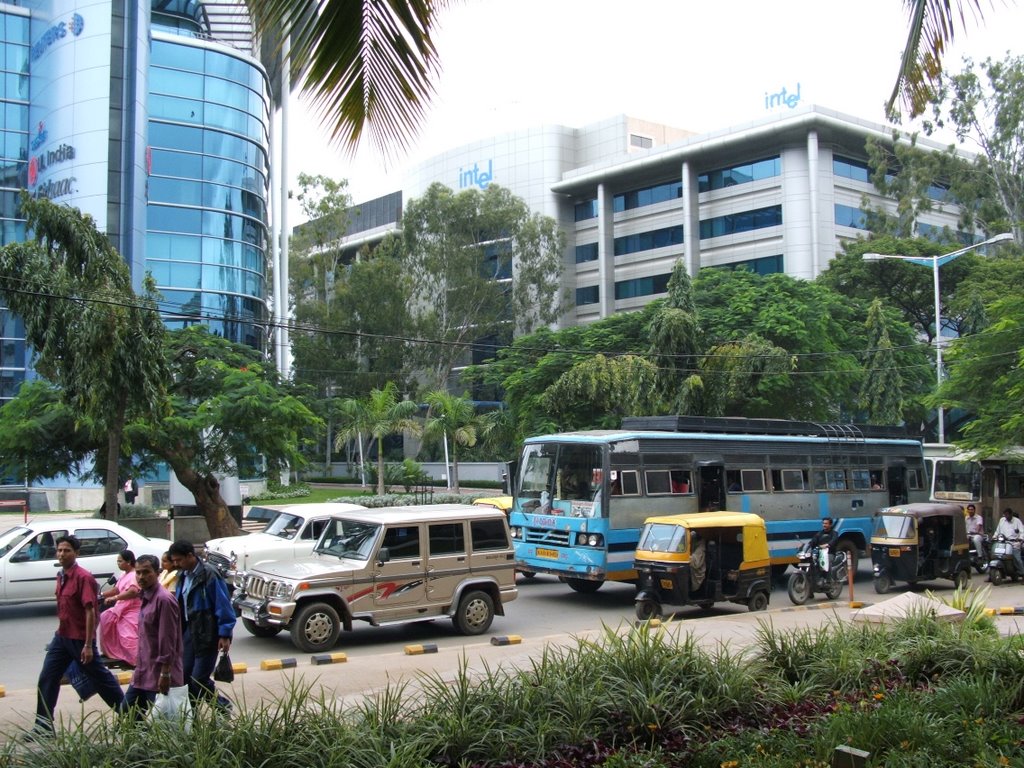
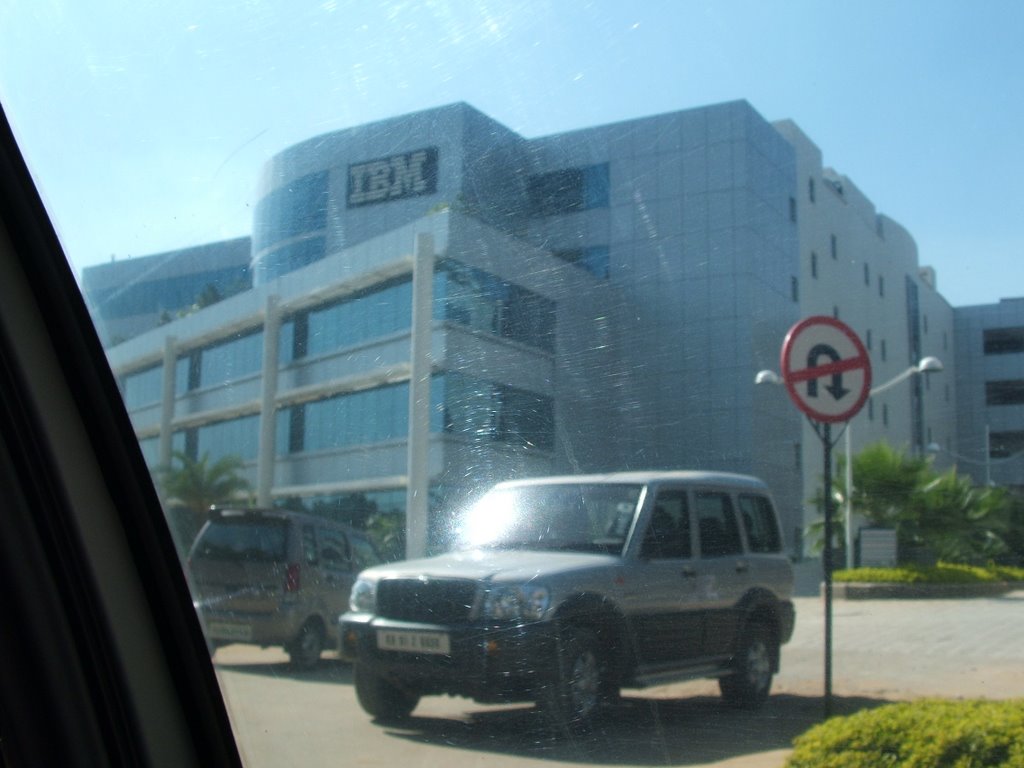
Back in September 2004, I got to make a trip to Bangalore, India. I saw an office building for almost every big-name tech company while I was there. Here's a few samples from my personal photo archives. They aren't great pictures as they were taken through the window of the taxi I was riding in.

First Oracle

  • Next Intel
    IBM
    And finally Microsoft


    Copyright © 2006 by Philip Hartman - All Rights Reserved

    The postings on this site are my own and don't necessarily represent IBM's positions, strategies, or opinions.
Wednesday, November 08, 2006

The Future Market

You've really got to view this new commercial showing how wireless technology can be a game changer in retail. See "The Future Market" (a play on words.. think super market).

I've been told the commercial is actually pretty old but I don't ever remember seeing it. Maybe IBM needs to try using it again.

Copyright © 2006 by Philip Hartman - All Rights Reserved


The postings on this site are my own and don't necessarily represent IBM's positions, strategies, or opinions.

Friday, November 03, 2006

Silo-ed Organization Abolishment and Other Variations on the SOA Theme

Brenda Michelson has some clever variations on the acronym SOA in her post Talking "S-O-A" with the Business.

Some of my favorites from her post include:

  • Strategy Offering Agility
  • Stream of Acronyms
  • Seizing Operational Agility
  • Silo-ed Organization Abolishment

The postings on this site are my own and don't necessarily represent IBM's positions, strategies, or opinions.